Black paint doesn’t scratch more than other colours — it just hides nothing. If you want to know how to remove scratches from a car with black paintwork, the answer is the same paint correction process I use on every colour, done with more care: identify whether you’re looking at swirls or genuine deep scratches, match the polishing paste to the defect, and finish gently so you don’t trade scratches for holograms. Black is the most demanding colour I work on, and the most rewarding when it’s done right.
In this guideSwirls or deep scratches?Why black shows everythingPreparationRemoving the scratchesMasking what won’t polish outKeeping black paint cleanFAQ
Swirl marks or deep scratches — which have you got?
This is the first question, because the fix is completely different. Swirl marks are the fine, circular spider-webbing you see around a light source — thousands of shallow scratches in the clear coat, put there by careless washing and drying. They cover whole panels but have no depth. A deep scratch is a single line you can find with your eye from a metre away — from a branch, a key, a badly parked trolley.
Swirls polish out fully, and fairly easily. A deep scratch only polishes out if it lives within the clear coat; once it’s cut through to the colour layer or primer, no compound on earth removes it — you can only improve its edges. Being honest about which one you’re facing saves you hours and clear coat.
| What you see | What it is | The fix |
|---|---|---|
| Circular spider-webbing under sunlight | Wash swirls in the clear coat | Medium polish — one-step correction |
| Hazy patches, buffer trails | Holograms from poor machine work | Ultra-delicate finishing polish |
| A distinct line, still same colour as the paint | Deep scratch within the clear coat | Aggressive compound, then refine |
| A line showing white, grey or metal | Scratch through to primer or metal | Polishing can only soften it — paint repair job |
Why does black paint show every mark?
Solid black has no metallic flake to scatter light, so every defect reflects straight back at you. On a silver car, the sparkle of the metallic particles camouflages fine scratches. On solid “uni” black there’s nothing to hide behind — swirls, dullness and even wipe marks stand out sharply.
The same property cuts the other way during correction: poor technique on black creates holograms and micro-marring that would go unnoticed on lighter colours. That’s why on black I always plan a delicate finishing stage — never end on an aggressive paste.
How do you prepare black paint for polishing?
Wash, clay, dry — skip any of these and you’ll grind dirt into the paint with the polisher. First a thorough wash to remove loose contamination. Then clay the paint to pull out what washing can’t shift — tar and tree resin especially, which smear under a pad. Finally dry the bodywork with a soft microfibre; dragging a coarse towel over black paint at this stage would create the very scratches you’re about to remove.
How to remove scratches from a car — matching the paste to the damage
Work from the defect down: aggressive paste only where it’s needed, delicate paste to finish everything. This is the sequence from my studio, using the SWAG polishing pastes:
Deep scratches — HEAVY CUT V.2. A few drops on a hard polishing pad. Work small areas — around 40×40 cm — with moderate pressure and low machine speeds. Wipe the residue off with a microfibre, check the result in good light, and repeat if the defect needs another pass. Resist the urge to press harder; on black, heat and pressure are how holograms happen.
Moderate swirls — ONE STEP POLISH. Medium-hard pad, medium speeds, even overlapping passes. This medium-abrasive paste takes out typical wash swirls and builds gloss in one stage — on most black daily drivers it’s the only correction step you need.
The finishing pass — PERFECT FINISH V.2. Soft pad, low speeds, no heavy pressure. This ultra-delicate paste removes the fine holograms the earlier stages leave behind and pulls out the mirror gloss black is capable of. On solid black I treat this stage as non-negotiable.
What about fine swirls you can’t quite chase out?
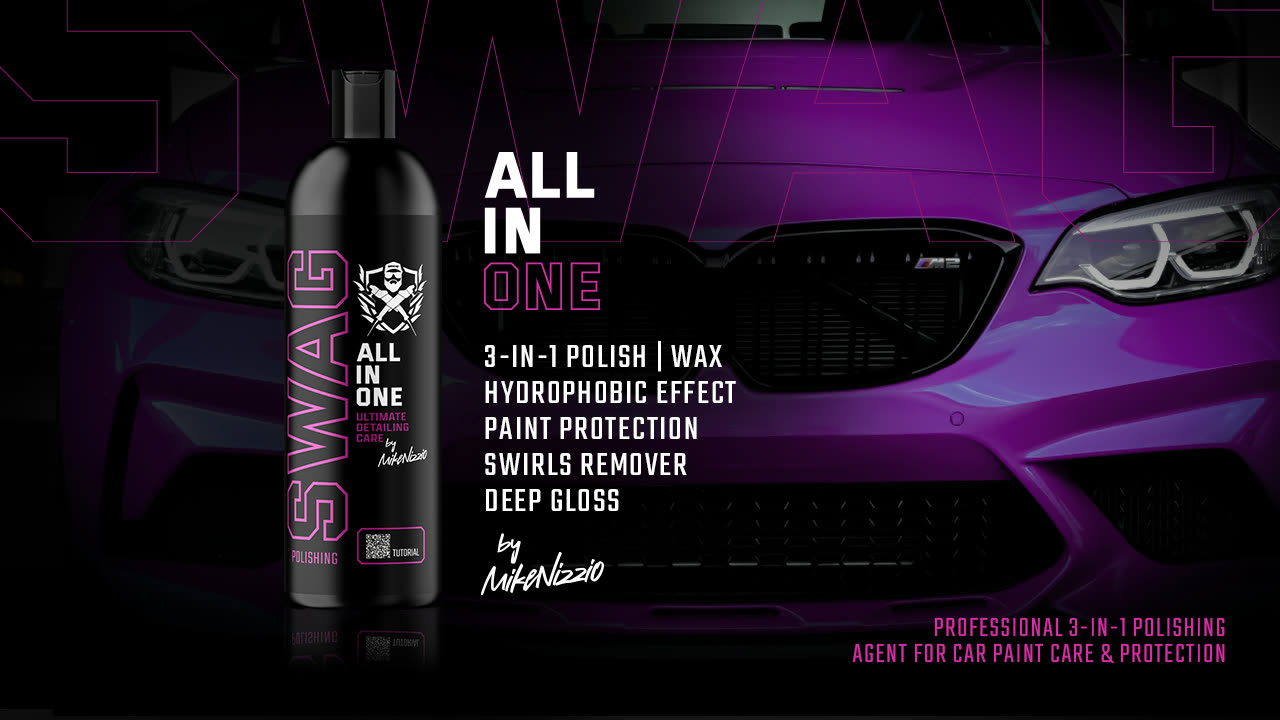
Mask them. For light circular marks on a car that doesn’t justify a full correction, an all-in-one product is the honest shortcut. ALL IN ONE AIO V.2 cleans the surface, fills and darkens fine scratches with a glaze, and leaves a protective wax layer — apply it with a soft applicator, leave it to work for around 15 minutes, then buff with a clean microfibre for deep gloss.
Watch me use it on paint start to finish:
How do you keep black paint looking corrected?
Protect it immediately, and change the wash habits that caused the swirls. After polishing, seal the finish with a wax — freshly corrected lacquer is bare and picks up marks fast. I’ve compared the options for black cars in my wax guide, and before any protection goes on, the paint must be degreased — the two-minute step covered in my panel wipe guide.
Then remember: swirls come from washing. Straight lines instead of circles, plenty of lubrication, clean soft microfibres, and never a dry wipe over a dusty panel. Correct once, wash properly, and black paint stays spectacular.
Frequently asked questions
Does polishing a car remove scratches?
Yes — any scratch contained within the clear coat, which covers swirls, wash marks and most light scuffs. Polishing levels the surrounding lacquer until the scratch edges disappear. Scratches that reach the colour coat or primer are beyond polishing and need paint repair.
Does ceramic coating protect against scratches?
Against wash marring and light abrasion, meaningfully; against real scratches, no. A coating is microns thick — it buys you slickness and chemical resistance, not armour. Think of it as swirl prevention, not scratch-proofing.
Does a quick detailer cause scratches?
Only if you use it on a dirty car. A quick detailer needs lubrication to be safe — mist generously and wipe gently with a clean microfibre on lightly dusty paint. Dragging any product over proper dirt will mar black paint.
Can you use nail polish on car scratches?
Please don’t. Nail lacquer is the wrong chemistry, the wrong colour and impossible to level — you’ll turn a polishable scratch into a visible repair. For clear-coat scratches use a polishing compound; for through-scratches, proper touch-up paint.
How do you remove water spots from black paint?
Fresh spots wipe away with a quick detailer. Mineral deposits that have dried on and etched need more — a dedicated water spot remover or a light polish. On black, deal with them early: hard water left baking in the sun etches rings that only a compound will shift.
Can you wax a matte black car?
No — conventional wax and polish are designed to build gloss, which is exactly what matte paint must not have. Matte finishes need dedicated matte-safe products; never machine polish them at all.
Every paste I reached for in this guide lives in our Paint Polishing range — formulated, tested and used in-house before it ever goes in a box.