Showing the single result
Which compound does your paint need?
Work up from the mildest grade that clears the defect. The test spot decides this, not the label.
Hard cutHEAVY CUT V.2
Deep swirls · sanding marks
The heaviest abrasive in the range, for paint that is genuinely damaged rather than just dull. It moves fast, and on soft or dark colours it leaves a light haze that needs refining afterwards.
- Deep scratches and wash marks
- Wool or firm cutting pad
- Always follow with a finer grade
View products →DefaultONE STEP POLISH
Most cars · single pass
The grade most cars actually need, and the sensible place to begin a test spot. It carries enough cut for everyday swirls, then breaks down to a clean gloss in the same pass.
- Corrects and finishes together
- Medium foam pad, DA or rotary
- The safest first compound
View products →FinalPERFECT FINISH V.2
Black paint · last pass
An ultra-fine polish built for depth rather than defect removal. On a soft pad at low speed it clears haze and holograms and takes dark paint to a wet, mirror gloss.
- Removes haze and holograms
- Soft finishing pad, low speed
- Made for black and dark colours
View products → Choosing a polish, and using it well
What people ask most about compounds, black paint and how much product to put on a pad.
What is the best car polish for black cars?
Black paint reflects everything, so swirls, holograms and hazing show up in light that hides them on silver. The dependable answer is two grades rather than one: ONE STEP POLISH to remove the defects, or HEAVY CUT V.2 if they are deep, then PERFECT FINISH V.2 on a soft pad to refine what is left. Keep speed and pressure down on that final pass, because heat and a clogged pad are what put holograms into dark paint in the first place. Then check the result with a panel wipe, since polishing oils flatter black paint more than any other colour.
How do you apply polish to a car?
Onto the pad, never onto the panel. Three or four pea-sized drops cover a section of roughly 40 x 40 cm: dab them across the area, then spread on the machine's lowest speed before you start your passes. Too much compound clogs the pad and smears, too little runs it dry and builds heat. Add a small amount of fresh polish for each new section rather than reloading the pad completely.
How often should you polish a car?
Once a year suits most cars, and plenty only need it every two or three. Every pass removes a few microns of clear coat, so polishing is a correction job rather than routine maintenance. If the paint has simply gone flat, top up the protection instead of cutting again. Careful washing and a maintained wax or coating are what keep the interval long.
Step by step
- Start mildDo a test spot with ONE STEP POLISH on a medium pad before reaching for anything harder.
- Step up if neededIf the defect survives, move to HEAVY CUT V.2 and a firmer pad on that same test area.
- Refine the finishFollow any heavy cutting with PERFECT FINISH V.2 on a soft pad at low speed.
- Wipe, then judgeStrip the oils with a panel wipe and inspect under a torch before you call it done.
Clear coat is finiteThere is only so much lacquer on a car, and every correction spends a little of it. Polish when the paint needs it rather than on a schedule, then protect the finish so the next interval is measured in years.
Car polish questions
The things customers ask before they open the first bottle.
Which compound should I start with?
ONE STEP POLISH, on a medium foam pad, on one test panel. It clears the majority of swirls on most cars in a single pass, and if it does not, you have lost nothing by trying it first. Move up to HEAVY CUT V.2 only when the test spot proves you need to, then refine with PERFECT FINISH V.2.
Can you polish a car by hand?
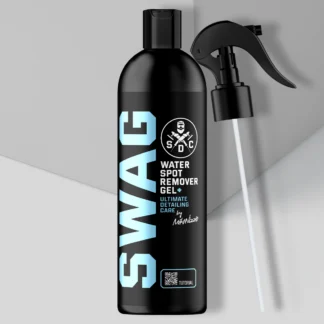
You can, but keep expectations modest. Hand pressure cannot generate the work these compounds are designed for, so deep swirls stay put, though light marring and dullness will improve. WATER SPOT REMOVER GEL+ is the exception, as it is made to be worked by hand on mineral deposits. For real correction a dual-action machine does in an hour what hands will not manage in a day.
Which size should I buy: 150ml, 250ml or 500ml?
150ml is a tester, enough to try a grade on your own paint before committing to it. 250ml covers a full car comfortably for most people. 500ml is the working size if you polish regularly or run a unit. The recipe is identical in every bottle; only the volume changes.
What removes water spots from car paint?
WATER SPOT REMOVER GEL+ is made for exactly that. Mineral deposits from hard water and sprinklers etch into the lacquer, and a gel worked by hand will often lift them without a full machine polish. It is worth trying before you commit to compounding, because unlike cutting it costs the clear coat nothing.
Do I need to degrease after polishing?
Yes, if you want to know what you have actually achieved. Compounds leave oils behind that fill fine defects and flatter the finish, so a panel wipe from Paint Degreasing shows the true result. It also leaves the surface bare so that wax, sealant or a coating can bond to the paint rather than to residue.
The stages either side of polishing
What has to happen before the machine comes out, and what has to happen after.
M
Written by
Mike Nizzio · Founder, SWAG Detailing13 years in detailing and a working studio in Poland. Every SWAG product is formulated, tested and filmed in-house before it earns the label.
Showing the single result