A good leather cleaner sits at a pH leather’s finish tolerates, cleans through mild surfactants rather than solvents or alcohol, foams so it works on the surface instead of soaking into the seat, and dries to a natural matte rather than a shine. If you’re asking what’s a good leather cleaner and what’s just blue liquid with a seat on the label, those four things separate them — and they matter because on almost every modern car you aren’t cleaning leather at all, you’re cleaning a coating on top of it. This is a buyer’s guide; for the step-by-step routine, see how to clean leather car seats.
In this guideWhat a leather cleaner isWhy pH comes firstYou’re cleaning the coatingWhy wipes dry leather outThe six-point checklistReady-to-use or concentrateOnly half the jobFAQ
What is a leather cleaner, exactly?
It’s a water-based solution built around mild surfactants, buffered to a pH that leather and its finish can live with, and designed to release soil so it can be wiped away rather than dissolving it into the material. That’s the whole brief.
What it isn’t is a degreaser with a nicer label. General cleaners work by being chemically aggressive enough to break dirt apart fast — fine on a wheel arch, quietly destructive on a seat. A leather cleaner gives up raw speed in exchange for not damaging what it’s cleaning, and makes the difference up with dwell time and a second pass.
Why pH is the first thing I check
Leather is a protein, and proteins are sensitive to pH in a way paint and plastic aren’t. Push a hide too far alkaline and you break down its structure and strip the oils that keep it flexible; too far acidic and you attack it from the other side. Both routes end at stiff, dry, eventually cracked leather — and neither shows up on the day you do it.
That delay is why pH is the most ignored spec in interior detailing. A strong alkaline cleaner looks brilliant on a filthy bolster: it lifts years of grime in one pass and the cloth comes away black. Three winters later that bolster has hairline cracks, and nobody connects the two events. So the first question I’d ask of any leather cleaner is whether the maker mentions pH at all — a brand that only talks about power has told you which trade-off it made.
On most cars, you’re cleaning the coating — not the leather
The vast majority of car seats built in the last few decades are pigmented, finished leather: a hide with a coloured polymer coating and a clear top layer over it. The colour, the even grain and the wipe-clean surface all belong to that coating — it’s why car leather survives kids, dogs, jeans dye and British weather at all.
That changes what you’re shopping for. Dirt on a finished seat sits on top of the coating, so a cleaner needn’t penetrate anything; it needs to release soil from a plastic-like surface so you can wipe it away. What it must not do is soften, cloud or thin that top layer — once the coating wears through you get colour loss, and colour loss is a re-dye job, not a cleaning job.
It’s also why “feeds the leather” on a cleaner label is mostly noise: on a coated seat, nothing you spray on reaches the hide. The seats that genuinely drink product are unfinished aniline and nappa hides — rarer, softer, easily stained, and wanting a gentler approach. There’s a five-second test for telling them apart in the FAQ.
Why cheap wipes and household cleaners dry the finish out
Because what makes them convenient — alcohol, solvents and high alkalinity — is exactly what a leather finish doesn’t tolerate. Alcohol and solvents evaporate fast, which is why wipes feel efficient; what evaporates takes plasticiser and oils with it, and can slowly haze or soften the clear top layer.
Household sprays fail differently: kitchen degreasers are built strongly alkaline on purpose, washing-up liquid leaves residue in the grain that holds dirt and moisture against the finish, and glass cleaner carries solvents that have no business on a seat. All of them look fine the first few times — that’s the trap.
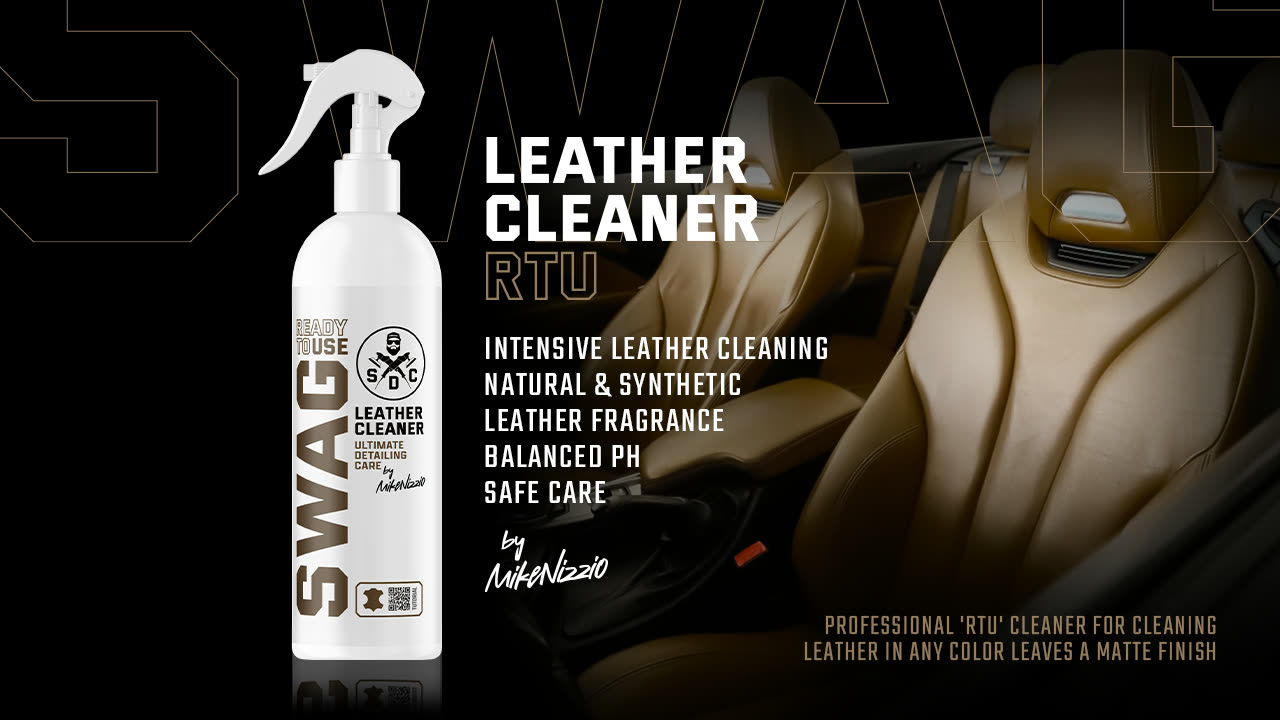
The version I see most is a car “kept clean” with wipes for five years: the seat isn’t dirty, it’s dull, faintly tacky, and thin along the bolster. You can’t clean that back — and a proper cleaner such as SWAG Leather Cleaner RTU with a foamer head works out cheaper per use than wipes anyway. DIY recipes are covered in the homemade leather cleaner warning.
What makes a good leather cleaner: six things I check on the label
Assessing any leather cleaner — including my own before it goes to production — I check six things, in this order.
- Stated pH safety for leather. Not “gentle”, not “pro strength” — a clear statement that the formula is balanced for leather. The non-negotiable one.
- No aggressive solvents or alcohol. If it smells like a hospital corridor, that scent is doing part of the cleaning at the finish’s expense.
- It foams. Foam isn’t a gimmick on leather, it’s control: it stays where the dirt is, discolours visibly as it works, and keeps liquid out of the cushion, stitching and perforations.
- It’s safe on coated and synthetic upholstery. Modern interiors mix leather, leatherette and vinyl, often in the same panel — a cleaner safe on only one is one you’ll second-guess every time.
- It dries matte. Leather that comes up glossy after cleaning has been coated in something, not cleaned. A slightly satin factory look is the correct result.
- You can control its strength — a concentrate you mix to the label ratio, or a ready-to-use at a strength the maker has judged safe. What you don’t want is a mystery mixture you can’t dial down.
Ready-to-use or concentrate — which should you buy?
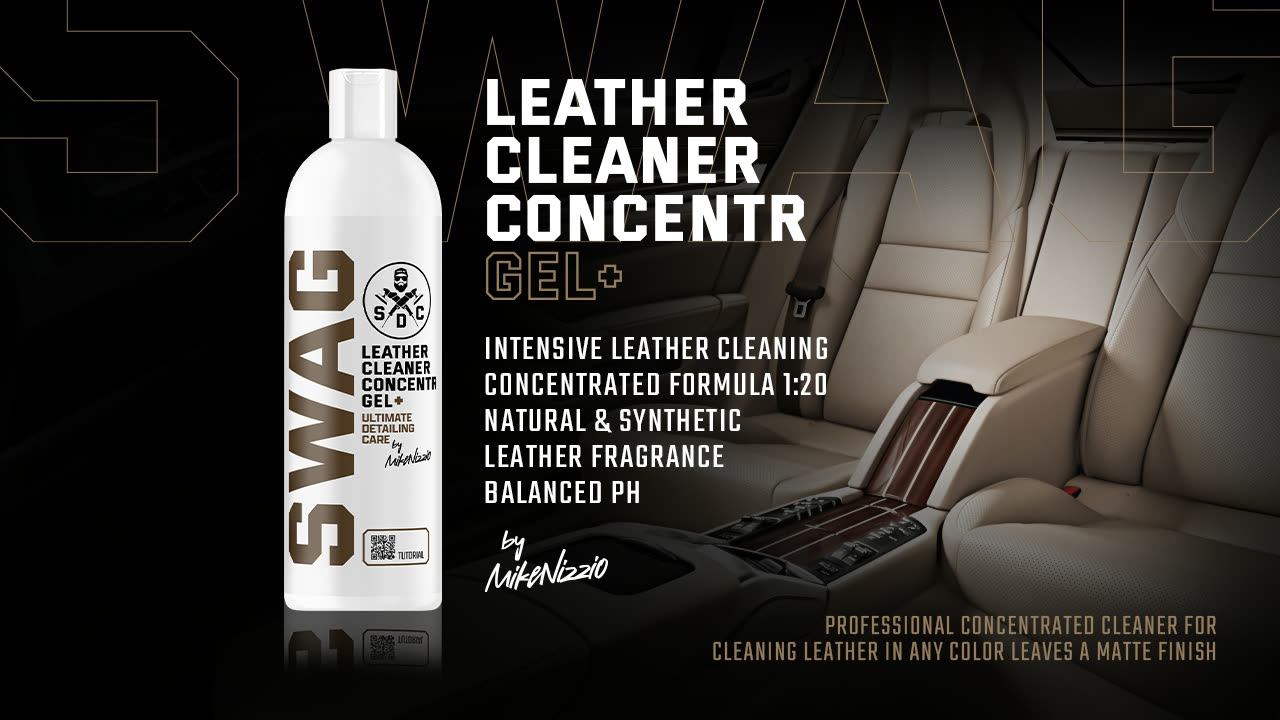
Buy ready-to-use if you clean one or two cars and want zero decisions; buy the concentrate if you clean often or want control over each pass. Both can be equally safe — the difference is who does the mixing.
| Format | Best for | Trade-off |
|---|---|---|
| Leather Cleaner RTU with foamer | Routine cleaning, or anyone wary of mixing | Fixed strength — heavy soiling needs more passes, not more power |
| Leather Cleaner Conc. Gel+ | Frequent use, jobs from light to neglected | You mix to the label ratio — and resist going stronger |
| Intensive Leather Cleaner RTU | Neglected interiors, ingrained dye transfer | More power than a weekly wipe-down needs |
Two warnings apply to both. Stronger is not better — the commonest mistake I see is mixing a concentrate hot because the seat is filthy, when the answer is two gentle foam passes. And be sceptical of clean-and-condition-in-one: cleaning removes, conditioning leaves something behind, and a product asked to do both usually does one of them badly.
A cleaner is only half of leather care
Cleaning opens the job; protection closes it. A clean, bare finish is when leather is most receptive and most exposed, so that’s when a conditioner such as SWAG Leather Conditioner Cream V.2 goes on, guarding against drying and cracking. The cleaner decides how long your interior lasts; the conditioner decides how it looks meanwhile. The protection range is in leather conditioning, the matched pairings in leather care sets.
Here’s a genuinely dirty Porsche Macan interior cleaned start to finish — it shows what the right cleaner does, and how gently it goes on:
Frequently asked questions
What is the best leather cleaner for car seats?
The best leather cleaner is the mildest one that still shifts the dirt in front of you: pH-safe, free of alcohol and harsh solvents, foaming, drying matte. Beyond that it’s a format decision — ready-to-use for simplicity, a concentrate to match strength to the job.
How do I tell whether my seats are coated or unfinished leather?
Put a single drop of water on a hidden area, such as the side of a seat base. If it beads and sits there you have finished, coated leather — the type in most cars, and the type everything above applies to. If it soaks in and darkens within seconds, you have an unfinished hide that needs a gentler, more cautious approach.
Can I use a car leather cleaner on a sofa or a jacket?
On coated leather furniture, yes — the finish is broadly the same problem, so the same chemistry applies. Test a hidden patch first, as furniture makers use a wider variety of finishes than car manufacturers. Suede, nubuck and untreated aniline are a different category and want a specialist product.
Does leather cleaner damage stitching?
A pH-safe cleaner used as foam doesn’t, because foam stays on the surface rather than soaking into the thread. Damage blamed on cleaners nearly always comes from over-wetting — soaked stitching stays damp long after the panel looks dry.
Pick the cleaner for the finish you actually have, then protect it. Both halves are in our leather conditioning range and the matched leather care sets.