The right way to clean leather car seats is with a pH-safe leather cleaner applied as foam, worked in gently with a soft brush, then wiped off with a microfibre — never soaked, never scrubbed. That is the exact method I use in my studio, and once you understand why each step matters, how to clean leather car seats stops being a mystery. Below I’ll walk you through my dilutions, my order of work and the mistakes that quietly ruin leather over time.
In this guideThe short answerWhat’s a good leather cleaner?Dilution ratiosStep by stepCream and light leatherLeather sofas at homeWhy regular cleaning mattersFAQ
How do you clean leather car seats? The short answer
Dilute a leather cleaner concentrate to match the level of soiling, apply it as foam, agitate with a soft brush, wipe with a microfibre and let the seat dry for about an hour before protecting it. The whole job on a typical set of seats takes me 30–40 minutes.
What you should never do is grab an all-purpose kitchen spray or a stiff brush. Car leather — whether natural or coated — has a finish layer that harsh chemistry and aggressive scrubbing slowly destroy. Everything in my routine is built around cleaning effectively while leaving that finish alone.
What’s a good leather cleaner?
A good leather cleaner has a pH that is safe for leather, works on both natural and synthetic upholstery, and lets you control its strength. After thirteen years of professional detailing, those are my three non-negotiables.
The product I formulated for this job is SWAG Leather Cleaner Conc. Gel+ V.3 — a concentrated gel with a safe pH that cleans natural and synthetic leather without attacking its structure. Because it’s a concentrate, you decide how strong to mix it, so one bottle covers everything from a light weekly wipe-down to a proper deep clean. It also leaves a subtle leather scent rather than a chemical one, which matters more than you’d think when you spend hours inside cars.
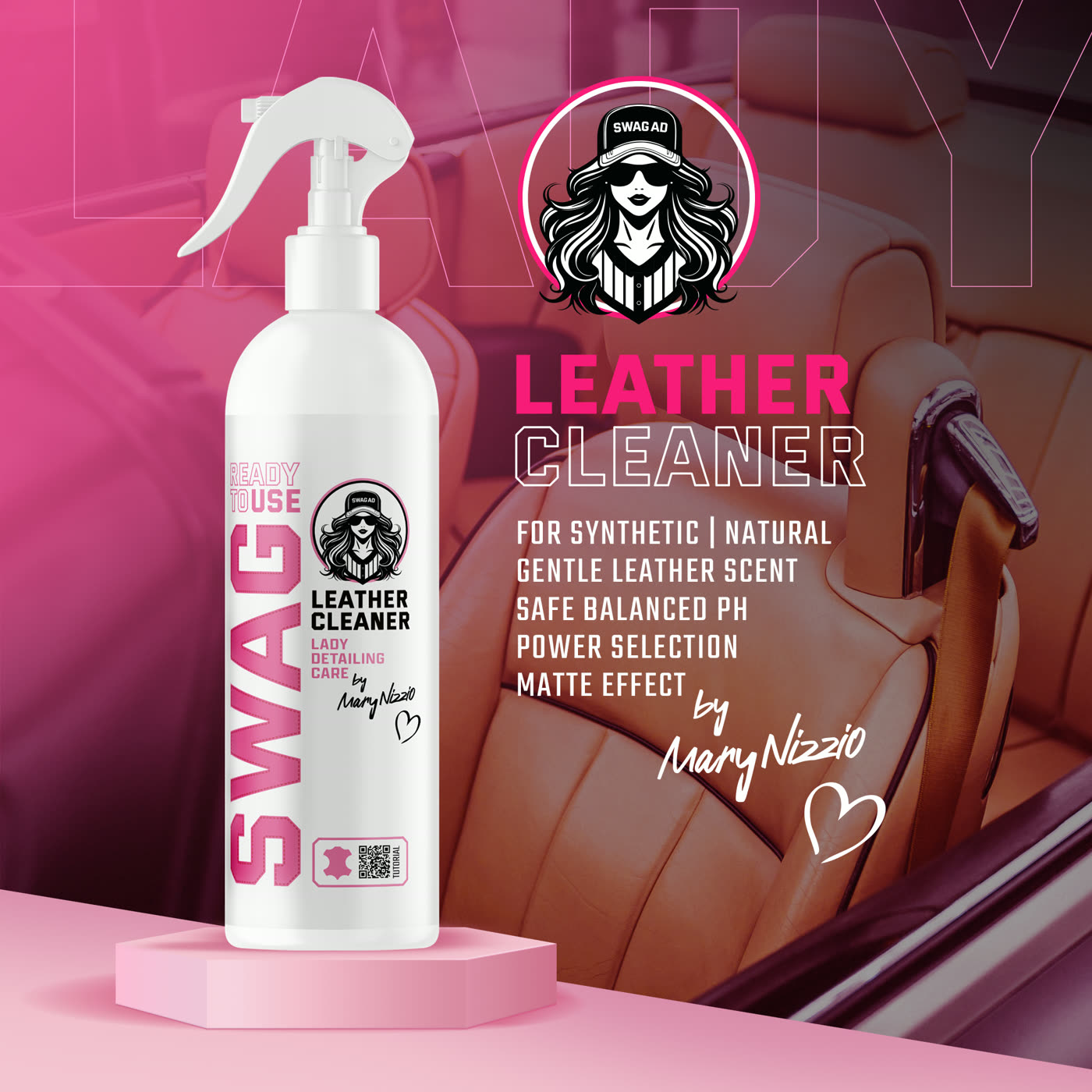
If you’d rather not measure anything, the ready-to-use version — SWAG Leather Cleaner RTU with a foamer head — is mixed to a safe working strength already and leaves a natural matte finish, not a greasy shine.
What dilution should you use?
Match the dilution to the dirt: stronger for neglected leather, weaker for routine care. These are the ratios I use with the concentrate, and I’d ask you not to improvise beyond them — stronger is not better with leather.
| Condition of the leather | Dilution | In practice |
|---|---|---|
| Dirty, neglected leather | up to 1:10 | 100 ml per 1 litre of water |
| Routine maintenance | up to 1:20 | up to 50 ml per 1 litre of water |
Start with the weaker mix. If the foam lifts the dirt, you’ve saved product and stressed the leather less. Only step up to 1:10 when the seat genuinely needs it — think years of jeans dye, grime in the grain, driver’s bolster wear.
How to clean leather car seats step by step
My studio routine has six steps: mix, foam, brush, wipe, dry, protect. Here is exactly how I do it, in order:
- Prepare the solution — mix the concentrate at the ratio from the table above.
- Apply as foam — I use the SWAG foamer so the product lands as a controlled layer of foam. This is the key trick: foam cleans the surface without soaking the cushion underneath. Soaked leather and wet stitching cause far more problems than dirt ever did.
- Agitate gently — work the foam with a soft leather brush. Light pressure; let the chemistry do the work, not your arm.
- Watch the foam — as it picks up dirt it changes colour. When it looks grubby, wipe everything off with a clean microfibre. On filthy seats, repeat the foam-and-wipe cycle rather than pressing harder.
- Let it dry — leave the leather to dry for around 1 hour before you sit on it or apply anything else.
- Protect — finish with SWAG Leather Conditioner Cream to guard against cracking and drying, or a leather wax if you prefer that finish. Cleaning opens the surface; conditioning closes the job.
Watch me run this exact process on a genuinely filthy interior — Porsche Macan, leather cleaning start to finish:
How to clean cream leather car seats
Cream and light leather is cleaned the same way — the difference is that you see every mistake, so discipline matters more. Light upholstery shows jeans dye transfer, grime in the grain and lazy wiping like a white shirt shows coffee.
On cream seats I always work panel by panel, with fresh foam and a clean side of the microfibre for each section, so I’m not dragging dissolved dirt from the bolster onto the seat base. Expect to repeat the cycle two or three times on dye transfer rather than reaching for something aggressive. And on light leather, protection afterwards isn’t optional — a conditioned surface takes on new dye and dirt far more slowly, which is exactly what you want on an interior that shows everything.
Does the same method work on a leather sofa?
Yes — a proper leather cleaner doesn’t care whether the leather is in your car or your living room. The cleaner I use works on natural and synthetic leather alike, and the routine transfers straight onto a leather sofa, armchair or office chair: foam, soft brush, microfibre, dry.
Two adjustments for furniture. First, start at the maintenance dilution — home leather rarely sees the abuse car seats do, and a gentle mix is usually plenty. Second, test a hidden spot first, exactly as you would in a car. Sofas from different makers wear different finishes, and thirty seconds behind a cushion tells you everything you need to know. I’ve cleaned my own sofa this way for years; it outlives any dedicated “furniture” product I’ve tried.
Why regular cleaning matters more than deep cleaning
Leather that gets a quick clean every few weeks almost never needs rescuing. Dirt left in the grain works like fine sandpaper every time someone slides across the seat, and grime holds moisture against the finish. That’s how leather ends up cracked and shiny in the wrong way.
The economics are simple: a maintenance wipe-down at 1:20 costs you ten minutes and a splash of product. Restoring a cracked driver’s bolster costs a specialist and real money — and it never looks factory again. Clean little and often, condition after, and the interior will still look right when you sell the car. Everything I use for this lives in our leather cleaning and leather conditioning ranges.
Frequently asked questions
How do you deep clean leather car seats?
Use the stronger 1:10 dilution (100 ml per litre of water), apply as foam, agitate with a soft brush and wipe off with a microfibre — then repeat the cycle until the foam stays clean. Deep cleaning is the same process as regular cleaning, done in more passes, not with more force.
What is the best homemade leather cleaner?
Honestly — there isn’t one I’d put on my own seats. Vinegar mixes and soap water either sit at the wrong pH or leave residue in the grain, and both slowly damage the finish. A dedicated leather cleaner with a safe pH costs little per use because it’s diluted; the risk-to-saving ratio of DIY mixes simply doesn’t add up.
How do you clean white leather car seats?
Same method as cream leather: gentle dilution, panel by panel, fresh foam and a clean microfibre face per section, repeated passes on dye transfer. Follow up with a conditioner every time — protected white leather resists new staining far better than bare leather.
What is leather cleaner, exactly?
It’s a cleaning solution formulated at a pH that leather’s finish tolerates, with surfactants that lift oils and grime without stripping the coating. That pH balance is the whole point — general-purpose cleaners clean well but sit outside the range leather is happy with.
How often should leather car seats be cleaned?
In my studio rhythm: a maintenance clean at 1:20 every few weeks, a deeper clean at 1:10 once or twice a year, and conditioner after every proper clean. Daily drivers with kids or dogs sit at the frequent end of that range.
Everything I used in this guide — the cleaner, the foamer and the conditioner — lives in our leather cleaning range. Mix it right, foam it on, and your leather will thank you for years.