If you have been looking up how to make natural leather cleaner for your car, here is the uncomfortable part: every popular kitchen recipe attacks the coating that makes your seat a seat. Vinegar, olive oil, baby wipes and washing-up liquid all fail for different reasons, and none of them fail loudly — the damage is slow, invisible for a year or two, then permanent. Below is the mechanism behind each one, because “just don’t” has never persuaded anybody.
In this guideThe thing every recipe misunderstandsVinegarOlive oil and baby oilBaby wipesWashing-up liquid and soapHow to make natural leather cleaner: the honest answerWhat I use insteadFAQ
The thing every homemade recipe misunderstands
You are not cleaning leather. You are cleaning a thin polymer coating sprayed onto leather. Practically every car seat on UK roads is pigmented, coated leather — that coating is what your hand touches, what holds the colour, and the only surface a cleaner ever meets.
Every recipe in the “natural leather cleaner” genre was written for something else entirely: old tannery hide, saddlery, furniture from another century. On a modern coated seat they are not gentle alternatives — they are chemistry aimed at the wrong target. And that coating is tough right up until it is not. It shrugs off one wipe with the wrong thing; it does not shrug off a hundred. Which is exactly why homemade cleaners feel harmless — the first attempt genuinely looks fine.
Vinegar: the acid that dulls the finish
Vinegar is acidic, and a leather coating is happiest close to neutral — so every wipe nudges the finish somewhere it does not want to be. It is the most recommended homemade leather cleaner online and, in fairness, it does shift surface grease. That is not the same as being safe.
Repeated acidic exposure works on the coating’s gloss and its plasticisers. Over time the seat goes flat and slightly chalky, especially on the bolsters where the mix gets rubbed in hardest. People read that as “the leather is drying out” and reach for an oil, which compounds the problem beautifully.
The other issue is control. Kitchen vinegar has no defined strength for this job, so nobody mixing at home knows what they have actually put on the seat — “half vinegar, half water” is a guess dressed up as a recipe.
Olive oil and baby oil: the grease that never leaves
Oil cannot absorb into a coated seat, because the coating exists specifically to stop liquids getting through. It nourishes nothing. It sits on the surface, and everything after that is downhill.
In the first hour it looks fantastic — that is the trap. The film fills micro-scratches and deepens the colour, so the seat photographs beautifully. Then dust and denim fibres bond to it, the surface turns slick and slightly sticky, and everyone who sits down presses that gritty film into the finish.
Then it turns. Food oils oxidise and go rancid, particularly in a hot car, and that smell is one you will not forget. Removing it is genuinely difficult, because the only things that shift heavy oil residue are harsher than anything I would put on leather. Perfectly good seats end up permanently blotchy this way — not through neglect, but through somebody trying to look after them. If the goal was suppleness, the mechanism you actually want is explained in do you actually need a leather conditioner?
Baby wipes: gentle on skin, quietly harsh on a finish
Baby wipes are formulated for skin, which repairs itself. A leather coating does not. They combine surfactants with alcohols and preservatives, and that mixture strips the protective layer off a seat a fraction at a time.
This is the one I see most in daily drivers, because a packet lives in the door bin and it is genuinely convenient. Nobody uses one wipe — they use one a week for four years. The result is a driver’s seat with a visibly duller patch exactly where the wipes land, while the rear bench still looks new.
There is a second-order problem too: wipes strip whatever protection you last applied, so the seat spends most of its life bare, taking UV and abrasion on an unprotected coating. A well-intentioned habit causing the exact wear it was meant to prevent.
Washing-up liquid and soap solutions
Washing-up liquid is engineered to strip fat off ceramic under hot water — it is far too aggressive for a leather coating, and it leaves residue behind. It is powerful, cheap and completely unsuited to the job.
Two things go wrong. It strips indiscriminately — the grime comes off and so does every trace of protection. And it is designed to be rinsed under a running tap, which you cannot do to a car seat. Whatever surfactant your cloth does not lift stays in the grain, slightly tacky, attracting dirt faster than before you started. The same applies to a household all-purpose spray, usually alkaline for the same fat-stripping reason. Both clean the seat; both cost you the finish over a few years.
How to make natural leather cleaner: my honest answer
You cannot make one in a kitchen that is safe for a coated car seat, and I would be lying if I published a recipe. A proper leather cleaner is not a secret ingredient; it is a controlled pH plus surfactants chosen to lift body oils without dissolving the coating, at a concentration somebody has actually tested. None of that can be judged by eye at a worktop. Here is the whole genre summarised, so you can see the pattern rather than take my word for it.
| The recipe | What it promises | What it actually does to the finish |
|---|---|---|
| Vinegar and water | “Natural degreaser” | Acidic attack on the coating — dulls it, dries the surface, uncontrolled strength |
| Olive or baby oil | “Feeds and softens the hide” | Never absorbs; becomes a dust magnet, then goes rancid and smells |
| Baby wipes | “Gentle enough for babies” | Surfactants plus alcohol strip the finish and remove all protection |
| Washing-up liquid | “It’s only soap” | Too aggressive, strips protection, leaves tacky residue you cannot rinse away |
| Household APC or bathroom spray | “An all-purpose cleaner cleans everything” | Alkaline and unbuffered for leather — fast cleaning, fast wear |
Take one thing from that table: every recipe delivers a good result on day one. That is why the myth survives. The bill arrives three or four years later, on the bolster you look at every day.
What I use instead — and why it costs less than you think
A pH-appropriate leather cleaner, applied as foam, agitated with a soft brush, wiped off — then protected. That is the whole method; the full walkthrough is in how to clean leather car seats properly.
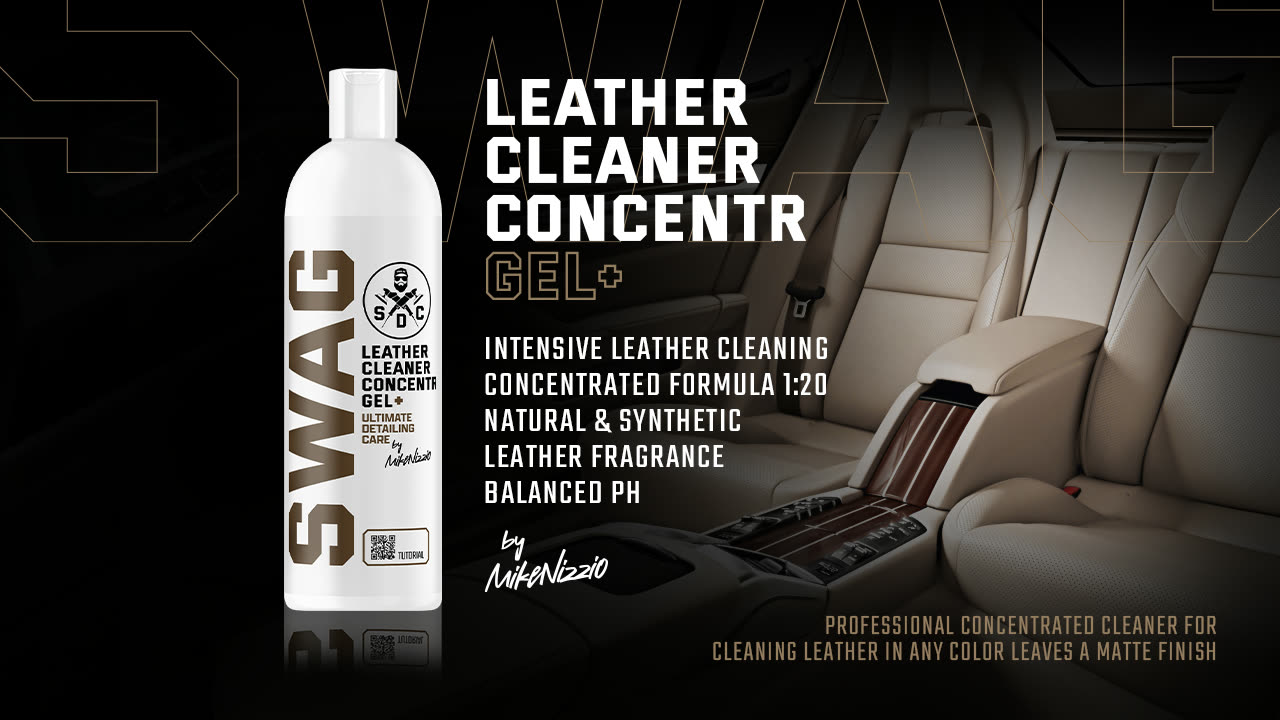
On most cars I use SWAG Leather Cleaner Conc. Gel+ V.3. It is a concentrate, so one bottle covers a lot of cars and you dilute to the ratio on the label rather than inventing one. If measuring irritates you, SWAG Intensive Leather Cleaner RTU arrives at a sensible working strength and leaves a matte finish rather than a plasticky shine.
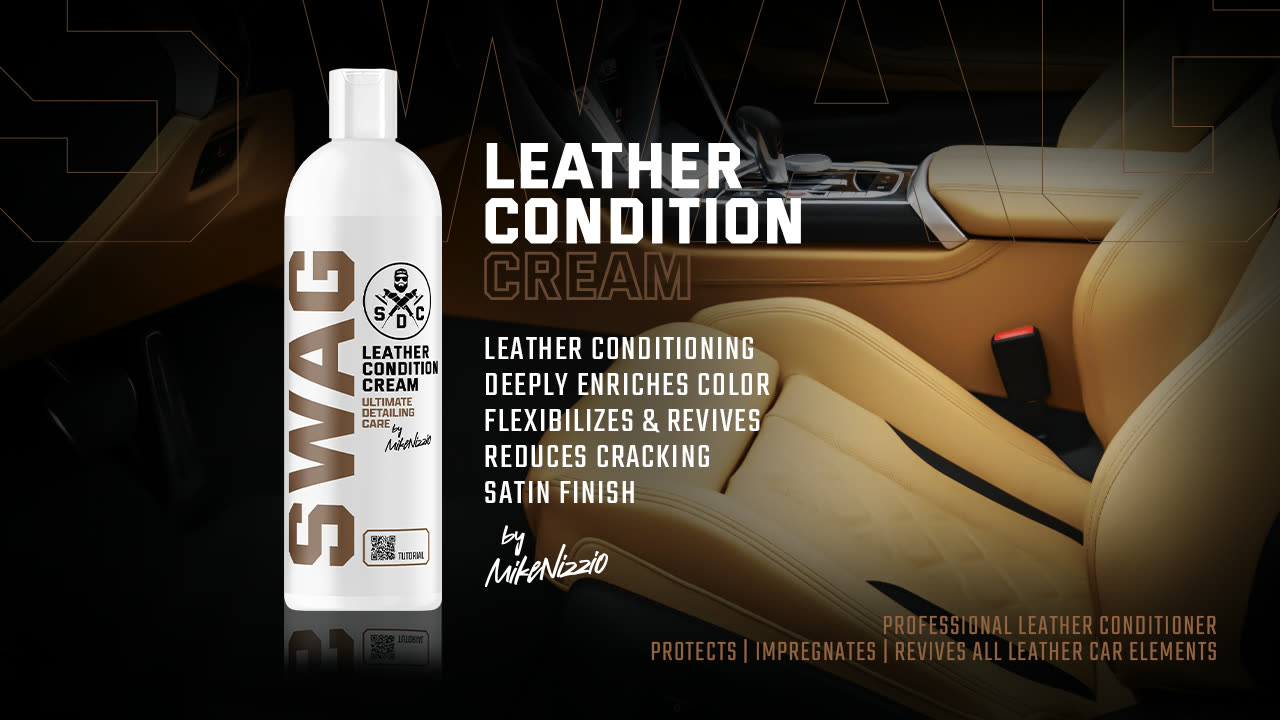
Then put the protection back, because cleaning always takes some away. SWAG Leather Conditioner Cream V.2 closes the job in my studio. This is the half of the routine homemade methods skip entirely, and it is the half that decides whether the seat still looks right in five years. The proper method, on an interior that had clearly seen a few shortcuts:
Frequently asked questions
What is the best homemade leather cleaner?
There isn’t one I would use on my own car. Every popular mix either sits at the wrong pH, leaves residue that cannot be rinsed, or strips the protective layer along with the dirt. A dedicated cleaner is heavily diluted in use, so the saving from a homemade version is tiny next to what a ruined seat costs.
Is vinegar safe on leather car seats?
No. Vinegar is acidic and a coated finish wants to be near neutral. One use will not visibly wreck a seat, but repeated use dulls the surface and eventually leaves a chalky look on high-contact areas. There is also no way to know the strength of what you have mixed.
Can you use baby wipes on leather car seats?
Not as a routine. They contain surfactants and often alcohols that strip the finish and remove any protection you applied. An emergency wipe on a fresh spill is one thing; a wipe a week for years is how you get a dull driver’s seat next to a perfect rear bench.
Does olive oil really damage car leather?
Yes. It cannot absorb through a pigmented coating, so it stays on the surface, collects dust and denim fibres, then oxidises and smells rancid in a warm car. Removing it needs chemistry harsher than anything you would normally put on leather, so the damage tends to be permanent.
I have already used a homemade cleaner — what now?
Stop, then do one careful clean with a proper leather cleaner to lift the residue, and protect afterwards. If oil was involved, expect two or three gentle passes rather than one hard one. What you cannot recover is coating that has already been thinned — from there it is about preventing further loss.
If you would rather spend ten minutes a month than pay a trim specialist later, the cleaner and the cream I use both sit in our leather conditioning range, and the leather care sets put the pair together with the accessories. Empty the kitchen cupboard back into the kitchen.