The safest way to learn how to wash a car is the two-bucket method: one bucket of shampoo solution, one of clean rinse water, a microfibre mitt, and a strict top-to-bottom order of work. Washing by hand is not just about looks — done properly it minimises the risk of scratching and extends the life of your paint’s protective layers. Done badly, it is where most of a car’s swirl marks come from. Here is exactly how I do it in the studio.
In this guideWhy hand wash?What you needStep by stepTwo buckets, explainedDrying and protectionWhat to avoidFAQ
Why wash a car by hand at all?
Because your hands give you what no machine can: control. Washing by hand means better control over the whole cleaning process, genuine safety for the paint — minimising the risk of micro-scratches — and the ability to properly clean the awkward spots an automatic wash never reaches: door shuts, badge edges, behind the mirrors.
Automatic washes use recycled brushes that have scoured a thousand dirty cars before yours. Every detailer can pick out a car that lives in them from ten paces — the paint is a haze of fine circular scratches. A careful hand wash, by contrast, actively preserves the finish and any wax or coating on it.
What you need before you start
The kit is short, but every item on it earns its place. My list, unchanged for years:
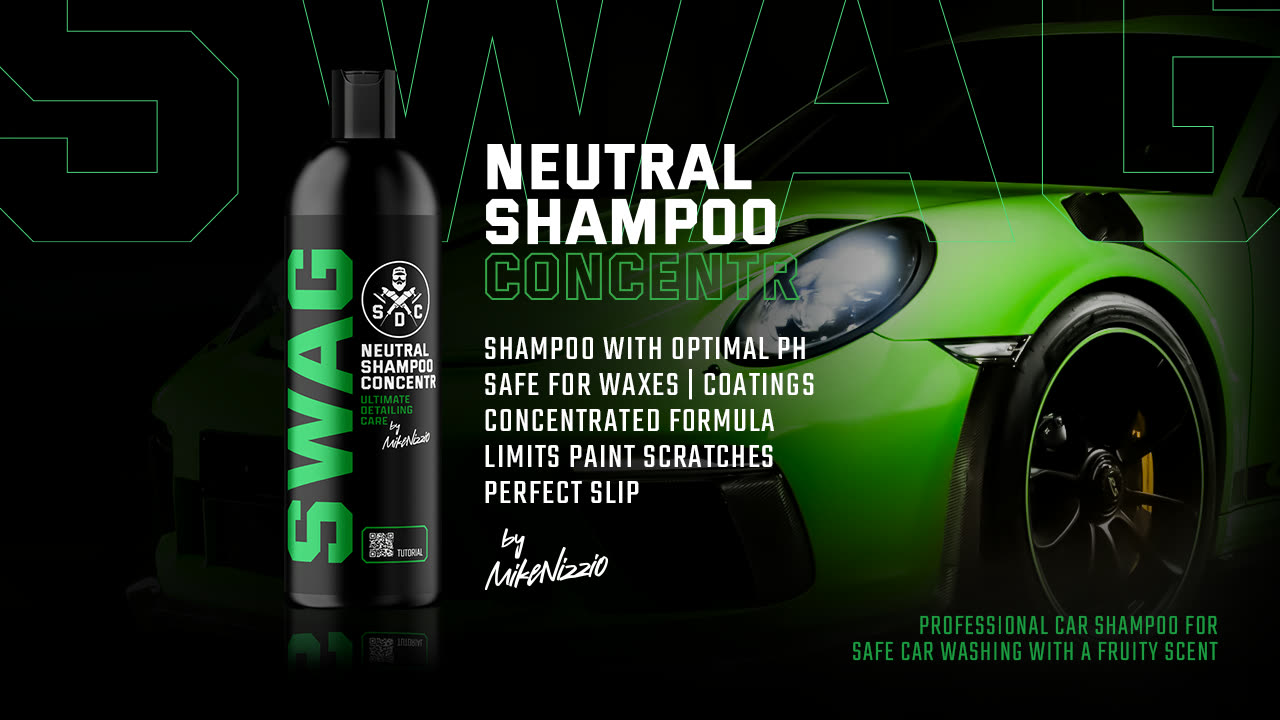
- A neutral-pH car shampoo — I use Swag Neutral Shampoo Concentr. V.3, which I formulated for exactly this job: safe for coatings, rich stable foam
- Two buckets — one for clean water, one for the shampoo solution
- A microfibre wash mitt
- A soft brush for the wheels
- A microfibre drying towel
- Water — ideally warm, never hot
- A protection product for afterwards, such as Swag Hydro Coat
No sponges, no hard brushes on paint, no washing-up liquid. The shampoo’s neutral pH is what keeps your waxes and protective coatings alive wash after wash — its slickness is what keeps grit sliding instead of scratching.
How to wash a car step by step
Shade, cool panels, pre-rinse, foam, then the contact wash from the roof downwards. The full sequence:
- Set up. Park in the shade and make sure the bodywork is cool. Rinse the car to remove loose dirt.
- Pre-wash first. Before the mitt touches anything, I foam the car — snow foam before the contact wash lifts off the grit that would otherwise end up in your wash mitt. This step is why my studio cars stay swirl-free.
- Mix the solution. Shake the shampoo bottle, then add 50 ml of shampoo to 10 litres of warm water and agitate until you have a dense foam.
- Wash with two buckets. Load the mitt in the shampoo bucket, wash one section, then rinse the mitt in the clean-water bucket before reloading. Always work from the top of the car downwards.
- Rinse. Flush the whole car with clean water and make sure no trace of foam is left to dry on the paint.
Watch me wash a car properly, start to finish:
Why the two-bucket method works
The second bucket exists for one reason: to keep the dirt you have just removed from going back onto the car. Every pass of the mitt picks up abrasive particles. Dunk that mitt straight back into your shampoo and you have turned your wash solution into liquid sandpaper.
Rinsing the mitt in the clean bucket after every section releases the grit and lets it sink, so the mitt returns to the paint clean and freshly loaded. Combined with the top-to-bottom order — the lower third of any car is always the filthiest — it means the dirtiest work happens last, with the least chance of dragging grime across clean panels. It costs you one extra bucket and zero extra time. There is no cheaper insurance for your paint.
Drying and protecting the finish
Blot, don’t rub — then protect. Use a microfibre drying towel and press it onto the panel to absorb the water rather than wiping aggressively. Rubbing a nearly-dry panel with whatever dust settled on it is one of the classic ways streaks and fine scratches appear at the very last step.
Once the car is dry, I finish with Hydro Coat for a hydrophobic layer that makes the next wash easier and keeps water from drying into spots. And one habit that separates detailers from car washers: when you finish, wash your kit. I run mitts, towels and pads through Swag Microfibre Wash so next weekend starts with clean tools, not last week’s grit.
What to avoid when hand washing
Four habits cause almost all wash-induced damage. Here is the honest do-and-don’t list from thirteen years of fixing other people’s wash marks:
| Do | Avoid |
|---|---|
| Wash in shade on cool bodywork | Washing in full sun — it dries product into streaks |
| Microfibre mitt and soft wheel brush | Hard, stiff brushes on any painted surface |
| Pre-rinse and foam before contact | Washing without preparing the surface first |
| Clean your mitt and towels after the job | Neglecting your accessories once you finish |
Frequently asked questions
What is the best car shampoo?
A neutral-pH concentrate with a rich, stable foam and plenty of slickness. Neutral pH keeps waxes and ceramic coatings intact; the foam and slip are what separate dirt from paint safely. That brief is exactly what Neutral Shampoo V.3 was formulated to — and one 500 ml bottle at 50 ml per wash bucket lasts a long time.
What can I use instead of car shampoo?
Nothing from under the kitchen sink, honestly. Washing-up liquid and household detergents are degreasers — they strip wax and dry out trim, and they have none of the lubrication a wash mitt needs. A proper shampoo is used at 50 ml a wash; it is the cheapest product in your routine.
What is a pre-wash and do I really need it?
The pre-wash is everything that happens before your mitt touches the car — a rinse plus snow foam that removes loose grit without contact. If you care about swirl-free paint, it is the most important scratch-prevention step there is. Full details in my snow foam guide.
Should you wash a car in the sun?
No. Sun-heated panels flash-dry shampoo and rinse water, leaving streaks and water marks. Wash in the shade, on cool bodywork — early morning or evening if the car lives outside.
How much car shampoo should I use?
With Neutral Shampoo Concentr. V.3: 50 ml into 10 litres of warm water, agitated into a dense foam. More is not better — an over-strong mix just rinses slower and risks residue.
Everything I used in this guide lives in our exterior washing range — the same shampoo, foam and coatings I reach for in the studio every day.