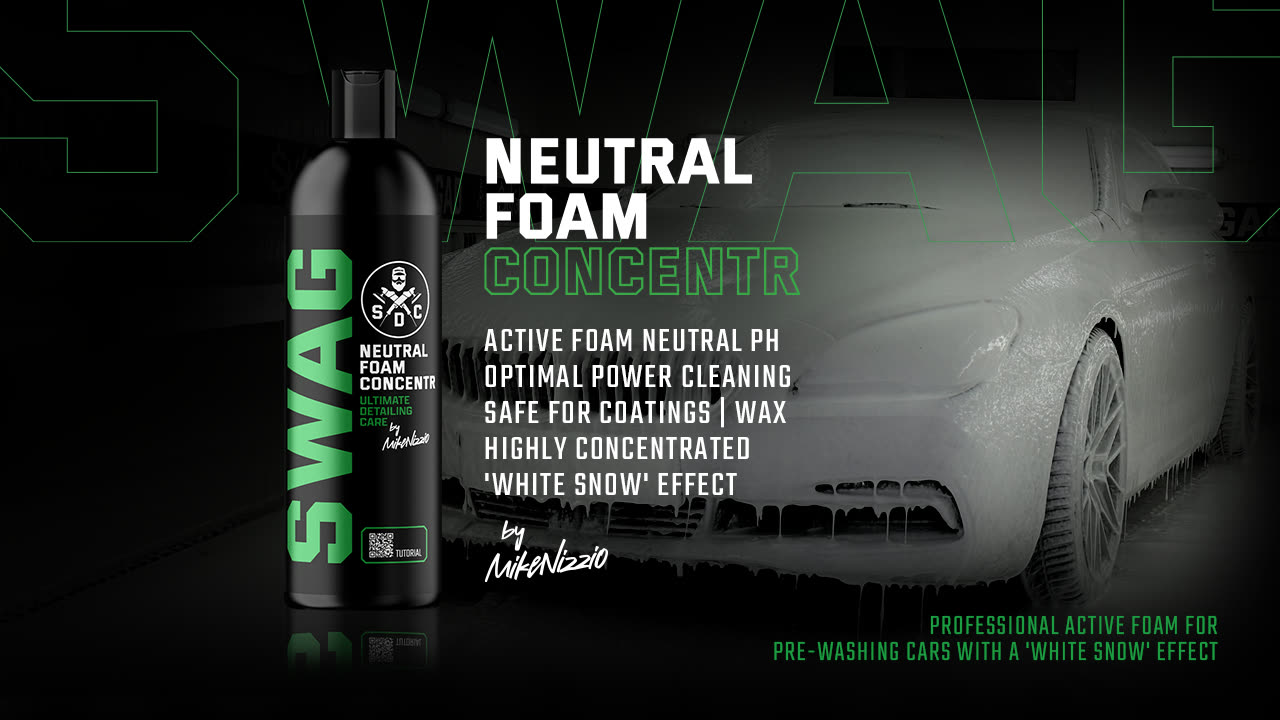
How to use snow foam in one sentence: apply it to a cool, pre-rinsed car, let it dwell for 4 to 10 minutes, then rinse from the top down — before anything touches the paint. Snow foam is a pre-wash: its job is to separate loose dirt, sand and road film from the paint so your wash mitt is not grinding grit into the lacquer. Done right, it is the single biggest scratch-prevention step in a wash.
In this guideWhat snow foam doesIs it a gimmick?Step by stepDilution ratiosAfter the foamStudio tipsFAQ
What is snow foam — and is it a pre-wash?
Yes: snow foam is a pre-wash, applied and rinsed off before the contact wash. “Pre-wash” simply means the cleaning stage that happens before your hands and mitt get involved — removing the loose dirt, sand and road deposits that cause micro-scratches when dragged across paint.
The foam I formulated for this, Swag Neutral Foam, creates an extremely dense foam that penetrates dirt and separates it from the paint surface. It is pH neutral, which matters more than people think: a neutral foam is safe for paint, waxes and ceramic coatings, so you can use it every single wash without stripping the protection you paid for. As a bonus, the “white snow” effect shows you exactly where you have coverage — and the fruity scent makes the job more pleasant than it has any right to be.
Is snow foam a gimmick?
The foam party trick is marketing; the pre-wash underneath it is not. I will be straight with you: a car covered in white foam looks great on Instagram, and plenty of people buy snow foam for the photo. But the mechanism is real — surfactants dwelling on the panel loosen and encapsulate dirt, and the rinse carries it off without contact.
The proof is in the rinse bucket. Foam a genuinely dirty car, rinse, and look at what comes off before your mitt ever touches the paint. Every gram of that grit is a gram you are not rubbing across your lacquer during the contact wash. If you care about keeping swirl marks out of your paint, the pre-wash stage is not optional — foam is simply the best way to do it.
How to use snow foam step by step
Cool car, shake the bottle, foam it, wait 4–10 minutes, rinse top to bottom — and never let it dry on the panel. Here is my studio process in full:
- Prepare the car. The bodywork must be cool to the touch. Never apply foam to hot panels or in full sun. If the car is heavily soiled, rinse it first with a pressure washer to knock off the worst.
- Mix the solution. Shake the bottle before use, then dilute for your applicator — the exact ratios are in the table below.
- Apply evenly. Cover the entire vehicle, paying particular attention to the lower panels, where road grime builds up most heavily.
- Let it dwell 4 to 10 minutes. This is where the work happens — the foam needs time to separate the dirt from the surface. Do not let it dry on the paint, or it will leave marks.
- Rinse thoroughly, pressure washer in hand, starting at the roof and finishing at the sills, so the dirt flows down and off.
Watch me do this start to finish:
How much snow foam to water? My dilution ratios
The ratio depends on the applicator — a pressure-washer lance works far stronger than a hand foamer. These are the ranges I formulated Neutral Foam around; go stronger within the range for dirtier cars, weaker for maintenance washes:
| Applicator | Dilution | In practice |
|---|---|---|
| Pressure-washer foam lance | 1:2 to 1:20 | 50–500 ml of foam per 1 litre of water |
| Hand pump foamer | 1:10 to 1:200 | e.g. 100 ml of foam per 1 litre of water |
| Hand sprayer | 1:10 to 1:200 | e.g. 100 ml of foam per 1 litre of water |
Notice what that first row means: you do not need a pressure washer to pre-wash a car. A hand foamer or even a simple sprayer does the job — you just run the product at a different concentration. Being able to adjust concentration to the level of dirt is exactly why I sell it as a concentrate; if you foam regularly, the 5-litre Neutral Foam is the sensible way to buy it.
What happens after the foam?
The foam only removes the loose dirt — the contact wash removes the rest. Once the car is rinsed, I go straight into a hand wash with Swag Neutral Shampoo and the two-bucket method — the full technique, including my exact shampoo dilution, is in the hand washing guide.
After the wash, two finishing moves: for hydrophobic protection I apply Swag Hydro Coat, then dry the car with a microfibre towel or a blower to avoid water marks. Foam, wash, protect, dry — that sequence is the backbone of every detail I do.
My tips after foaming a few thousand cars
Most snow foam problems are heat problems. Full sun makes foam dry too fast, which is how people end up with residue marks on a car they just cleaned. Work in the shade, on cool panels, and rinse before the foam dries — always.
Two more habits worth stealing: test any new product on an inconspicuous area before covering the whole car, and store your foam somewhere cool and dry, protected from frost and direct sunlight — the surfactant package keeps its performance far longer that way. Small things, but the small things are the job.
Frequently asked questions
How long should snow foam sit on the car?
Between 4 and 10 minutes — long enough to separate the dirt from the paint, never long enough to dry on the panel. On a warm day work shorter and keep an eye on it; dried foam leaves marks.
Do you need a pressure washer for snow foam?
No. A pressure-washer lance gives the thickest foam, but a hand pump foamer or hand sprayer works too at a 1:10–1:200 dilution. A pressure rinse afterwards is ideal, but the pre-wash principle works with any decent flow of water.
Can snow foam damage paint, wax or coatings?
A pH-neutral foam like Neutral Foam is safe for paint, waxes and ceramic coatings — that is precisely why I formulated it neutral. What can cause damage is letting any product dry in the sun, or using harsh alkaline traffic film removers on freshly waxed paint every wash.
How to make snow foam at home?
Honestly — don’t. Washing-up liquid in a foamer makes bubbles, not a pre-wash: it lacks the dirt-encapsulating surfactant package and is not formulated to be safe on waxes and coatings. Foam is one of the cheapest products per wash in detailing; it is the wrong place to economise.
Is snow foam enough on its own, without a hand wash?
For a quick freshen-up of a lightly dusty, protected car, a foam-and-rinse helps. But foam only removes loose dirt — bonded road film needs the contact wash. Think of foam as making the hand wash safe, not replacing it.
Everything I used in this guide — foams, shampoos and drying aids — lives in our exterior washing range, formulated and tested in my own studio.