Car detailing for beginners comes down to one thing: doing simple steps in the right order with the right product for each stage. That is the entire secret. Every detail I do in my studio — decontamination, washing, polishing, paint protection — follows a fixed sequence, and once you learn it, professional results at home stop being a marketing phrase and become a Saturday morning. This is the routine I would give my younger self.
In this guideWhere to startYour first kitThe routine, step by stepShould beginners polish?ProtectionBeginner mistakesFAQ
Where should you start with car detailing for beginners?
Start with the wash — not the polisher. If you are new to car detailing, the single most valuable skill is washing a car without adding scratches, because every other stage builds on it. A perfect polish means nothing if your next wash puts the swirls straight back in.
Detailing is much more than an ordinary car wash — it is complete care of every detail, and the reason beginners get overwhelmed is that they see the whole mountain at once. Ignore the mountain. Learn one process at a time: pre-wash, contact wash, drying, protection. Polishing and decontamination come later, when the basics are automatic.
Knowing which product to use, at which stage of the work, and how to get the best result without the risk of mistakes — that is the framework I built the whole SWAG system around, and it is the framework of this guide.
Your first car detailing kit: what you actually need
A beginner needs surprisingly little: an active foam, a neutral shampoo, two buckets, a wash mitt, drying towels and one easy protection product. Everything else can wait. Do not buy fifteen shampoos — buy one good one and learn what it does.
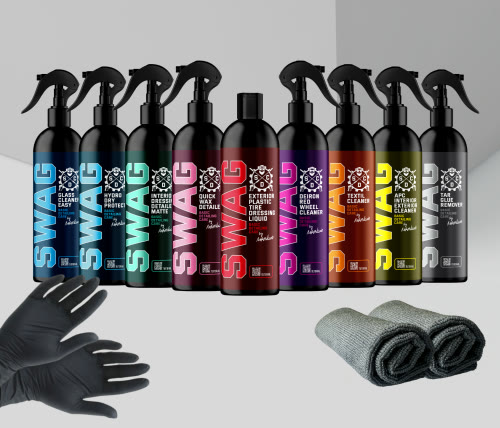
Because “what do I buy first?” is the question I get most on the channel, I put together the Swag Beginner Detailer Set Basic Line — nine products covering each stage of the routine below, with accessories, each one described by application and correct method of use. It exists precisely so a beginner always knows which bottle comes out at which moment. If you prefer to build your own, all the stage-by-stage bundles are in our sets category.
Your first full routine, start to finish
The routine is: rinse, foam, contact wash, rinse, dry, protect — always top to bottom, always in that order. Here is the whole first detail on one table:
| Step | What you do | Why it matters |
|---|---|---|
| 1. Prepare | Park in shade, bodywork cool to the touch, rinse off loose dirt | Hot panels dry products into streaks |
| 2. Pre-wash foam | Cover the car in snow foam, let it dwell, rinse top to bottom | Lifts grit off before anything touches the paint |
| 3. Contact wash | Two buckets, mitt, neutral shampoo; wash top-down, rinse the mitt after every section | The two buckets keep the grit out of your mitt |
| 4. Rinse | Flush every panel until no foam remains | Residue dries into smears |
| 5. Dry | Blot with a microfibre drying towel — don’t scrub | Rubbing a damp panel is how swirls happen |
| 6. Protect | Apply an easy sealant or spray protection | Protected paint stays cleaner and washes easier |
Steps 2 and 3 each have their own full write-up, with the exact dilutions and dwell times I use in the studio: how to use snow foam and how to wash a car by hand with the two-bucket method. Read both before your first go — the numbers matter.
And if you would rather watch than read, here is a full winter-grime wash from start to finish:
Should a beginner polish their car?
Not on day one — polishing is stage three, and the best car polish for beginners is the one you buy after mastering the wash. Machine polishing removes fine scratches and restores gloss brilliantly, but it is the one stage where a mistake costs real money, because you are physically abrading the paint.
My advice: run the wash-and-protect routine for a month or two first. You will learn how your paint behaves, your wash technique will stop creating new swirls, and only then is correcting the old ones worth your time. When you are ready, work through my machine polishing guide before the polisher ever touches a panel.
Protection: the easiest win in detailing
Protection is the highest reward-to-effort step a beginner has. After drying, I finish with Swag Hydro Coat — a touchless coating that leaves the paint hydrophobic, so water beads and sheets off instead of drying into spots.
The pattern I use is simple: protect the car once, then every wash afterwards gets faster and safer, because dirt bonds less and rinses off more easily. It is the step that makes the whole routine self-reinforcing — the car stays cleaner between washes, so each wash is gentler on the paint.
The mistakes I see every beginner make
Almost every scratched bonnet I see in the studio comes from the same four habits. Washing in full sun, so product dries onto hot panels and streaks. Skipping the pre-wash and dragging grit around with the mitt. Using hard brushes or sponges on paint. And neglecting the accessories — a mitt left dirty after the wash is a bag of grit waiting for your next Saturday.
None of these cost anything to fix. Shade, foam first, soft microfibre only, and rinse your kit when you finish. Do those four things and you are already ahead of most people who have been washing cars for decades.
Frequently asked questions
What’s the best car detailing kit for a beginner?
One that maps products to stages instead of throwing bottles at you. That is the thinking behind the Beginner Detailer Set Basic Line: nine products, one per job, each described by application and method, plus the accessories to use them correctly.
How do you polish a car for beginners?
Start with the least aggressive option: a finishing polish on a soft pad, working a small test section first. But master the safe wash before you polish at all — otherwise you are correcting scratches your own wash keeps creating.
Do I need a pressure washer to start detailing?
It helps, mainly for the pre-wash stage, but it is not a requirement. Snow foam can be applied with a hand pump foamer or sprayer as well as a pressure-washer lance — the dilutions differ, and I cover both in the snow foam guide.
How long does a first full detail take?
Plan a relaxed half day for the wash-and-protect routine above. It gets much faster: once the car carries protection and your movements become automatic, a maintenance wash is closer to an hour.
Everything in this routine lives in our detailing sets range — matched products, no guesswork, the same chemicals I use in the studio.