If you are buying your first car polish machine, buy a dual action — a DA — and don’t agonise over it. A DA gives you the great majority of the correcting power with a fraction of the risk, because the head stalls under pressure instead of cooking the panel. A rotary cuts faster and, in trained hands, finishes beautifully — but it removes clear coat with an enthusiasm that beginners never see coming until the damage is done.
In this guideWhich car polish machine should a beginner buy?DA vs rotary, side by sideWhy a DA is so forgivingWhat a rotary is actually forWe sell no machines — so here’s the honest bitWhat to buy alongside the machineFAQ
Which car polish machine should a beginner buy?
A dual-action polisher. For nine out of ten people asking this question, that is the entire answer. Not because a DA is a toy version of a rotary, but because it does the job almost everyone actually has — clearing wash swirls and light scratches from a daily driver — with a safety margin wide enough to survive a learning curve.
Polisher, car polish buffer, DA, orbital — the names get used interchangeably online, but mechanically there are only two families of machine, and the difference between them is the whole of this article. The rotary is not the better one, it’s a different one — a production tool for people who cut paint for a living. It punishes hesitation, pressure in the wrong place and a moment’s inattention on a body line. I’ve seen more paint ruined by a first rotary than by anything else in this trade.
DA vs rotary polisher: side by side
Same pad, same compound, two completely different risk profiles. Read the “if it goes wrong” row twice — that’s the one that decides this for a first machine.
| Dual action (DA) | Rotary | |
|---|---|---|
| How the head moves | Orbits and spins at the same time, and the spin is free to stall | Direct drive — one axis, forced rotation, never stalls |
| Cutting speed | Slower — needs more passes on hard defects | Fastest correction available, by a wide margin |
| Heat at the paint | Spread around by the orbit, builds gradually | Concentrated under the pad, climbs fast |
| If it goes wrong | A dull patch, a bit of haze, some wasted time | Burnt-through lacquer on an edge — a respray, not a re-polish |
| Holograms | Effectively none — the random motion prevents them | Common until your technique is genuinely good |
| Learning curve | An afternoon to be safe, a weekend to be decent | Months, ideally supervised, ideally on scrap panels |
| Best suited to | Swirls, light scratches, gloss stages, coating prep | Heavy oxidation, sanding marks, trade volume work |
| Buy it first? | Yes | No — and possibly never |
Notice that the rotary wins on speed and loses on everything a first-timer needs. Speed only pays when you polish cars for a living. On your own car an extra pass costs ten minutes; a burnt wing costs a panel.
Why a DA is so forgiving
The safety comes from one mechanical detail: the pad’s rotation isn’t forced. The backing plate is driven round an offset orbit, and the pad is free to spin on top of that orbit. Lean on it, hit a curve, catch a wing mirror surround — and the rotation simply stops while the orbit carries on.
A stalled pad is a pad that has stopped cutting. That is your safety valve: a DA fails by doing nothing, whereas a rotary fails by doing far too much. It also means the abrasion is scattered in a random pattern rather than laid down in concentric arcs, which is why a DA doesn’t leave holograms in the first place.
The honest downside is pace. On hard paint with deep defects a DA can feel like it’s polishing the air, and that’s the point where people convince themselves they need a rotary. Nine times out of ten the answer is a firmer pad. Here’s a proper cutting stage when the combination is right:
What a rotary is actually for
A rotary earns its place on work a DA genuinely cannot do in sensible time: heavy oxidation, refining sanding marks after body repair, and trade work where hours are money. It is not a status symbol and it is not “the professional choice” — it’s a specialist tool with a specialist’s risk attached.
The danger is heat. Because the pad is driven and never stalls, every second in one spot pushes energy into the clear coat, and lacquer that gets too hot doesn’t warn you — it goes matte, then it’s gone. Edges, raised body lines, the tops of wings and the rims around badges have the least material on the car, so they are exactly where a rotary burns through first, and it happens in seconds rather than minutes.
The second cost is holograms: hazy shimmering bands that show up in low sun after careless rotary work. They’re why so many cars leave a cheap valet looking worse in daylight than they did going in, and clearing them means another machine stage with an ultra-fine paste like PERFECT FINISH V.2. If you’ve inherited a rotary, learn it on scrap panels — not on your own bonnet.
We sell no machines — so here’s the honest bit
I have nothing to gain from which machine you buy, which is exactly why I’ll tell you it matters less than you think. The pad and the compound do the cutting. The machine just carries them and decides how much trouble you can get into.
In the studio I get wildly different results from the same tool purely by changing the foam and the paste on it: a firm pad with a medium abrasive behaves like a different machine to a soft pad with a finishing polish. That’s the variable worth learning — and where people waste money is buying a heavier machine to solve what was really a saturated pad or the wrong grade of compound.
So whichever machine ends up on your bench, the process is identical: wash, decontaminate, dry, then a test spot with the mildest pad and paste combination you own, stepping up only when the mild one has demonstrably failed. My guide on choosing between heavy cut, one step and a finishing polish walks through that ladder in detail.
What to buy alongside the machine
Budget for the consumables before you spend the last of your money on the tool. A good machine with one tired pad and no degreaser produces a worse result than a modest machine with a proper kit behind it.
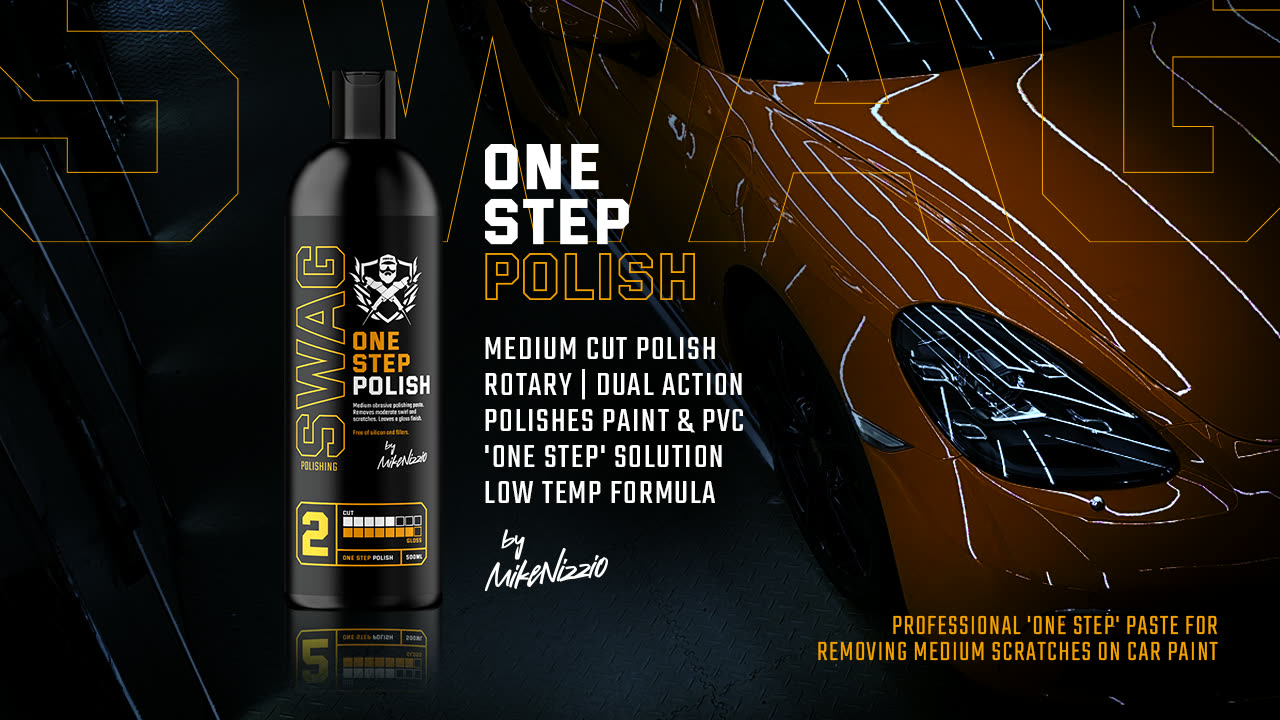
- One medium compound. ONE STEP POLISH corrects normal swirls and finishes down to gloss in a single stage, which is exactly what a DA is good at.
- Several pads, not one. A pad that has soaked up spent compound stops cutting — you want spares so you can swap mid-job rather than fight a clogged one.
- Pad primer. BOOST POLISH PAD PRIMER+ conditions the foam and improves glide, which keeps temperatures sensible.
- A degreaser and a decent torch. Polishing oils flatter the paint, so wipe the panel down and inspect it under a strong light held at a low angle.
- Masking tape. Trim, badges and rubber seals stain, and the tape costs pennies compared to the alternative.
One last habit that separates a good result from a mediocre one: keep the foam clean as you work. A pad full of dried paste generates heat and drags — I’ve covered why that ruins a finish in why dirty polishing pads ruin your finish.
Frequently asked questions
Can a beginner use a rotary polisher?
Physically yes, sensibly no. The machine won’t tell you when the lacquer is getting too hot, and by the time a panel looks wrong the damage is permanent. If you’re determined to learn one, practise on scrap panels until the finish comes out hologram-free before you go near a car you care about.
Will a DA polisher remove deep scratches?
It removes what the abrasive can reach, and so does a rotary — neither machine fills anything in. If your fingernail catches in the scratch it has gone through the clear coat and no polishing removes it safely. For everything shallower, a DA with a firmer pad and a cutting compound usually gets there, just with more passes.
What speed should I run a DA polisher at?
Low to spread the paste over the section, up to a working speed for the passes themselves, then back down to refine. Watch the pad rather than the dial — if it has stopped rotating you’re leaning too hard or the panel is too curved, and extra speed won’t fix either.
Do I really need a machine at all?
Only if the paint has defects worth correcting. Plenty of cars just need a proper wash, decontamination and fresh protection, and an all-in-one applied by hand will lift the gloss without touching a machine. Check how often you should polish a car before you spend anything.
Whichever machine you end up buying, the compounds, primers and pad care that decide the result live in our Polishing range — developed and tested in my own studio.