How often to polish a car, honestly: once a year at the very most, and for most cars a lot less than that. Polishing is not maintenance — it is correction. Every single pass shaves a microscopically thin layer off the clear coat, and you never get that layer back. So you polish when there are defects worth removing, not because a calendar says it’s time.
In this guideSo how often should you polish a car?Polishing is correction, not maintenanceThe decision rule I useFrequency by how the car actually livesWhat to do in betweenSigns the paint genuinely needs itHow many times can one car be polished?FAQ
So how often should you polish a car?
A proper machine correction belongs in a car’s life once a year at most — and on a well-kept car, once every few years or only once ever. That is not me being lazy on your behalf. It’s the only answer that respects what polishing physically does.
The reason the internet gives you “twice a year” is that most advice quietly confuses polishing with waxing. Waxing is protection, and yes, that gets topped up regularly. Polishing is abrasive. Treating an abrasive process as a routine is how perfectly healthy paint ends up thin, patchy and — on the worst cases I’ve seen — burnt through on the edges of a bonnet.
Polishing is correction, not maintenance
A polish doesn’t fill a scratch — it removes the clear coat around it until the scratch is no longer there. That’s the whole mechanism. A swirl mark looks white because its edges scatter light; the abrasive planes the surrounding lacquer down flat so the light reflects evenly again.
Which means the clear coat on your car is a finite budget. It’s measured in microns, it is the layer carrying all the UV protection, and there is far less of it than people imagine. Spend it on defects that were actually bothering you and it’s money well spent. Spend it every spring on a car that had nothing wrong with it, and one day the lacquer gives up — it goes cloudy, then it starts peeling, and no polish on earth fixes that. Only a respray does.
This is the single most important thing I tell people who have just bought their first machine: the polisher is a repair tool. You wouldn’t sand a table every month to keep it looking nice.
The decision rule I use in the studio
Polish when there are defects worth removing, and only then. Before I put a machine on any customer car, it has to pass three questions:
- Can I see defects on clean, dry paint in strong light? Not in the shade, not on a wet car — water hides everything. If nothing shows up under a torch held at a low angle, there is nothing to correct.
- Do those defects actually bother the owner? Some swirling on a ten-year-old daily driver is normal wear. If you can only see it when you go looking with a light in a dark unit, leave it alone.
- Will washing, decontaminating or a coat of protection fix it instead? An enormous share of “dull paint” is bonded contamination, tar spots or a layer of old, tired product. Clean it properly first and half the time the “defects” wash off.
Three yeses, and the car gets polished. Anything less, and it gets washed and protected instead. That rule has saved a lot of clear coat over thirteen years.
Frequency by how the car actually lives
How fast a car earns its next correction depends almost entirely on how it gets washed. Here’s how I’d advise, by situation:
| How the car lives | What the paint needs | Realistic interval |
|---|---|---|
| New or nearly new | Protection only — there is nothing to correct yet | Not until defects appear |
| Daily driver, careful two-bucket wash | Swirls build slowly; a single one-step stage clears them | Every two to three years |
| Daily driver, automatic brush washes | New swirls faster than you can polish them out | Change the wash method first — polishing yearly is a losing race |
| Garaged weekend car | Almost nothing; gloss top-ups at most | Every few years, finishing grade only |
| Just bought, unknown history | The one time a full correction really pays | Once, properly — then maintain |
| Already corrected two or three times | Caution — measure the paint before cutting again | Finishing polish only, if anything |
| Ceramic coated | The coating is the wear layer — maintain that, not the lacquer | Don’t polish until the coating comes off |
Notice how much of that table is about washing rather than polishing. That’s deliberate. If you fix how the car gets cleaned, the polishing question mostly answers itself — my hand wash guide covers the technique that stops swirls appearing in the first place.
What to do in between: maintain, don’t re-cut
Between corrections you keep the gloss up with protection, not with abrasives. This is the part people skip, and it’s the part that makes a single correction last for years.
The maintenance ladder, cheapest and gentlest first: wash properly and dry with a soft towel; top the protection up with a spray product like HYDROPHOBIC QUICK DETAILER+ after each wash; and once or twice a year, refresh the whole car with an all-in-one.
ALL IN ONE AIO V.2 is the honest middle ground here — it cleans, lightly glazes and protects in one pass, so it lifts the look of tired paint without meaningfully cutting into it. It won’t remove a real scratch, and I’d never pretend otherwise, but as a between-corrections job it gives you 80% of the visual result for none of the clear coat. Here’s the product in use:
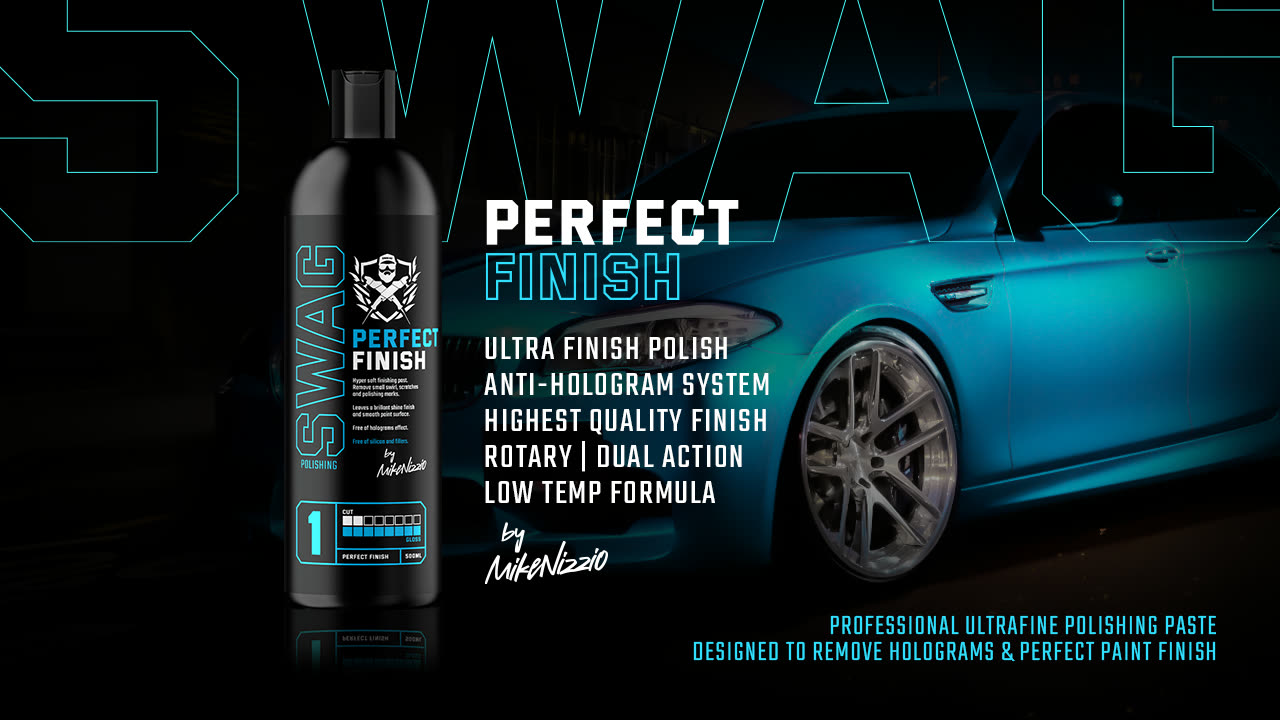
If the paint genuinely does need a touch of machine work — say a few isolated marks rather than the whole car — reach for the mildest grade you own. PERFECT FINISH V.2 is ultra delicate by design, so it lifts gloss and clears fine marks while taking a fraction of what a cutting compound would.
Signs the paint genuinely needs polishing
Look for defects that survive a proper clean — those are the ones only abrasives will shift. The honest triggers are:
- Spiderweb swirls under direct sun or a torch — circular scratch patterns from washing and drying.
- Holograms — hazy, shimmering bands, usually left behind by a rotary machine at a bodyshop or a cheap valet.
- Dullness that survives washing and claying — genuine oxidation, most common on older reds and single-stage paint.
- Etching from bird lime, tree sap or water spots that stays after chemical treatment. My water spot guide covers when to try chemistry first.
- You’re about to apply a coating. A ceramic locks in whatever is underneath, so this is the one time a full correction is genuinely worth doing on schedule.
How many times can one car be polished?
Nobody can give you a number, because it depends on the paint you started with — but every correction gets you closer to the limit. Factory paint on a modern car is thinner than the paint on cars from thirty years ago. Cheap resprays and repaired panels are thinner again, and that’s where I’ve seen lacquer go through fastest.
Two practical safeguards. First, if a car has a correction history or any repainted panels, use a paint thickness gauge before you cut — it’s the only way to actually know. Second, treat the edges and body lines as no-go zones for aggressive work: there is less material on a raised edge, so that’s where burn-through happens first.
And once the correction is done, the aim is never to do it again. Protect the bare lacquer straight away, wash it kindly, and the answer to “how often should I polish?” becomes “I haven’t needed to since.”
Frequently asked questions
How often should you polish a new car?
You shouldn’t, not yet. New paint has no defects to correct, so polishing it only spends clear coat for no gain. Wash it carefully and protect it — the first correction should come when you can actually see marks that bother you.
Can you polish a car too much?
Yes, and it’s irreversible. Each pass removes clear coat, so repeated corrections thin the layer that carries the UV protection. Thin lacquer eventually goes cloudy and starts to fail, and at that point only a respray puts it right.
Is polishing the same as waxing?
No — and mixing them up is why people over-polish. Polishing is abrasive and removes material to fix defects. Waxing adds a sacrificial protective layer on top and removes nothing. Wax often, polish rarely.
How often should you polish black paint?
Black shows every mark, so the temptation to polish constantly is strongest — resist it, because the clear coat on a black car is no thicker than on a white one. Correct it once properly, then be religious about wash technique and protection.
Should I polish my car before winter?
Only if it needs correcting anyway. What genuinely helps before winter is fresh protection on clean paint, not fresh abrasion — road salt attacks unprotected surfaces, and a polish leaves the lacquer bare until you seal it.
Does hand polishing remove less clear coat than a machine?
Usually yes, because you simply can’t generate the same work rate by hand — but that also means it corrects far less. It’s not a safer way to do a correction; it’s a lighter job entirely, best suited to all-in-one products and small touch-ups.
When your paint has genuinely earned a correction, the compounds are in our Paint Polishing range — and the products that keep you from needing one live in Paint Maintenance.