Water spots are mineral deposits, and how to remove water spots depends entirely on the surface: on paintwork you dissolve them with a hand-applied gel remover, on glass you polish them off with a dedicated glass polish. Use the paint product on paint and the glass product on glass — mixing them up is the mistake that turns a ten-minute fix into a repair job. Here is how I handle both surfaces in the studio.
In this guideWhat water spots actually areRemoving spots from paintRemoving spots from glassPaint vs glass at a glanceSpots that won’t budgeStopping them coming backFAQ
What are water spots and why won’t they wash off?
When a drop of water evaporates, everything dissolved in it stays behind — calcium, magnesium, whatever minerals your local water carries. That white crusty ring is no longer water; it’s a mineral deposit bonded to the surface. Shampoo doesn’t touch it because shampoo removes dirt, and this isn’t dirt.
Worse, in the UK’s hard-water regions the problem compounds: sprinkler overspray, rain drying in sunshine, a rinse the car “dried by itself” — every cycle leaves another layer. Left long enough on paint, the deposit can etch into the lacquer itself. That’s why I treat water spots as a today job, not a someday job.
How to remove water spots from car paint
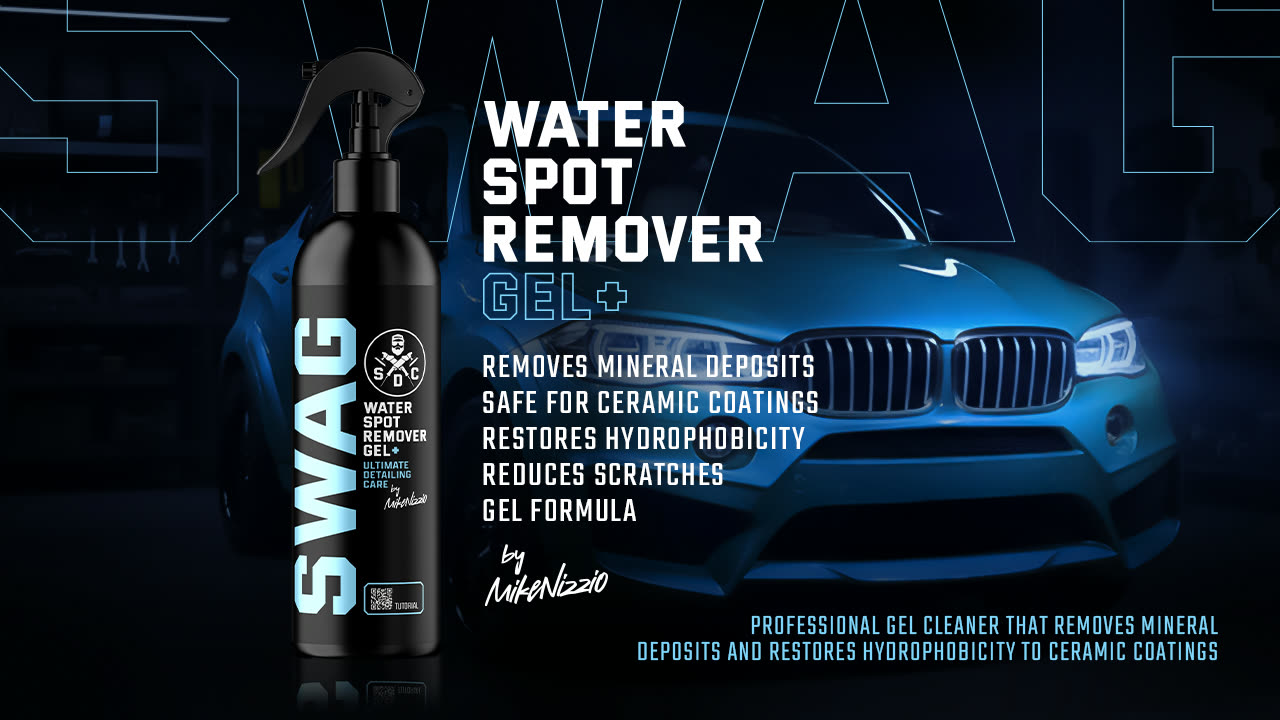
On paintwork I use SWAG Water Spot Remover Gel+ — a gel formulated to dissolve water spots and mineral deposits, applied by hand. No machine, no abrasives: the gel does the work chemically, which is exactly what you want on lacquer.
My routine: wash and dry the panel first, so the gel meets the deposit rather than a layer of road grime. Work on a cool panel in the shade. Apply the gel to an applicator, spread it over the spotted area, let it work on the deposits, then wipe the panel clean with a microfibre. Heavier accumulations may need a second pass — repeat the cycle rather than scrubbing. The gel consistency matters here: it stays where you put it instead of running off vertical panels, so a door or wing gets the same contact time as a bonnet.
One caution from experience: work panel by panel and check your results in good light as you go. It keeps you honest about what’s a mineral deposit (gone after the gel) and what’s etching (see below).
How to remove water spots from glass
Glass is harder than lacquer and holds mineral deposits more stubbornly — so on glass I switch to SWAG Water Spot Glass Polish, a polishing paste with abrasive power matched to glass. This is mechanical removal: the paste physically polishes the deposits off the surface.
Clean the glass first with a glass cleaner so you’re polishing deposits, not grime. Apply the paste to a firm applicator pad, work it over the spotted glass in overlapping passes with steady pressure, then wipe the residue off and inspect. Old, baked-on spots — the classic wing-mirror and side-window rings — take repeated passes; the deposit came off in layers, so it leaves in layers too.
And this is the whole reason two products exist: abrasives tuned for glass are far too aggressive for paint lacquer, while a chemical gel gentle enough for paint struggles against deposits fused to glass. Right tool, right surface. A streak-free wipe-down with SWAG Glass Cleaner+ afterwards shows you the true result.
Paint vs glass at a glance
If you remember one thing from this article, make it this table.
| Paintwork | Glass | |
|---|---|---|
| Product | Water Spot Remover Gel+ | Water Spot Glass Polish |
| How it works | Chemically dissolves deposits | Mechanically polishes deposits off |
| Application | By hand, applicator, gel stays put | Firm pad, overlapping passes |
| Swap them? | No — glass abrasives damage lacquer; paint-safe chemistry is too gentle for glass | |
What if the water spots won’t budge?
If the remover dissolves the mineral crust but a ghost of the ring remains in the paint, the deposit has etched the lacquer — and etching is a defect in the surface, not on it. No spot remover will fix that, because there is nothing left to remove; the lacquer itself is marked.
The honest fix is machine polishing, which levels the lacquer down to the bottom of the etching. Mild etching comes out with a finishing polish; deeper craters need a proper correction. I’ve covered that whole process in my machine polishing guide for first-timers. The practical takeaway: the earlier you remove water spots, the more likely you stay in “wipe on, wipe off” territory instead of polishing territory.
How to stop water spots coming back
Every water spot starts as a drop of water that was allowed to dry on the car — so prevention is about drying and beading. Three habits cover it:
- Dry the car after every wash. A drying towel costs minutes; letting the car “air dry” manufactures water spots out of your rinse water.
- Don’t wash in direct sun. On a hot panel, rinse water evaporates before you can dry it. Shade, mornings, evenings.
- Keep the surfaces protected. On a hydrophobic surface water gathers into beads and rolls off instead of lying flat and evaporating. A quick spray of SWAG Hydrophobic Quick Detailer+ after drying keeps paint beading between washes.
None of this makes a car immune — parked next to a sprinkler, anything spots — but protected, regularly dried paint gives deposits far fewer chances to settle in.
Frequently asked questions
Can a car wash remove water spots?
No — washing removes dirt, but water spots are mineral deposits bonded to the surface, and shampoo chemistry doesn’t dissolve minerals. A wash is still the right first step, so the remover works on the deposit itself rather than through a film of grime.
Does a quick detailer remove water spots?
Fresh, light spots sometimes wipe away with a quick detailer, but established deposits need a dedicated remover. Where a quick detailer genuinely earns its keep is prevention — a hydrophobic layer keeps water beading so drops roll off instead of drying in place.
Does Windex or household glass cleaner remove water spots?
Not the established ones. Household glass cleaners are surfactant-based and remove grime, not bonded mineral deposits. If the spots survive a normal clean, they need mechanical removal with a glass polish.
How do you remove water spots from car seats?
Fabric seats are a different mechanism — those rings are dried cleaning residue, not minerals, and the fix is re-wetting and cleaning the whole panel evenly so it dries at one rate. I’ve covered it step by step in my fabric seats guide.
What is the best water spot remover?
There’s no single best — there’s the right one per surface. For paintwork, a hand-applied chemical gel that dissolves deposits without abrasion; for glass, a polishing paste with abrasive power matched to glass. The products live in our paint polishing and glass polishing categories.
Both removers from this guide live in our glass polishing range and the paint polishing range — one for each surface, exactly as it should be.