A musty smell in a car is water sitting somewhere it shouldn’t be, and until you find that water and dry it out, no air freshener will fix it. In thirteen years of detailing I’ve never cured a damp smell with fragrance — but I’ve cured hundreds by pulling up a soaked carpet, clearing a blocked drain or replacing a pollen filter that had turned into a sponge. The order below is the one I use in the studio: find the water, dry the car, clean what the damp fed on, then make it smell good.
In this guideWhy cars smell mustyFind the sourceWhy fragrance alone failsDrying the car outCleaning carpets and seatsFilter, vents and plasticsFragrance lastFAQ
Why does my car smell musty or damp?
Because moisture, warmth, darkness and a bit of organic dirt are everything mould and bacteria need — and a car floor offers all four. What you smell isn’t the water; it’s what grows in it, feeding on the dust, skin cells and spilled drinks in every carpet. That’s why it spikes after rain, on the first warm day of spring, and when the fan comes on after the car has stood.
It’s also why the smell returns after you’ve “cleaned everything” — the foam under the carpet is still wet, and you only cleaned the top of it. Treat the smell as a symptom and you’ll chase it forever; treat it as a leak report and you’ll fix it once.
Find the source before you mask it
Start with your hands, not a spray bottle: lift every mat and press a palm or a folded kitchen towel hard into the carpet underneath. A rubber mat can look bone dry on top while the carpet beneath holds half a litre of water. Do the same in the boot — lift the floor panel and the spare wheel, the most common hidden reservoir I find. Where it’s wet tells you what’s leaking.
| Where it’s wet or worst | Usual cause | How to check |
|---|---|---|
| Front footwells, wet only after rain | Blocked scuttle drains, leaves and moss in the plenum | Open the bonnet and clear the channel at the base of the windscreen by hand |
| Damp headlining, water down the A-pillar | Blocked sunroof drain tubes | Trickle water into the sunroof channel and watch whether it drains out behind the wheels |
| Wet along one sill only | Perished door seal, torn door membrane, blocked door drains | Run water down the closed door and watch the inside of the sill |
| Boot smells far worse than the cabin | Boot seal, tail light gaskets, water in the spare wheel well | Lift the boot floor and take the spare wheel out completely |
| Smell hits the moment the fan comes on | Saturated pollen (cabin) filter and damp evaporator | Pull the filter out and look at it — most sit behind the glovebox |
One exception: a sweet smell with an oily film hazing the inside of the windscreen is coolant, not damp — that one is a garage job, not a detailing job.
Why an air freshener on its own makes it worse

Because fragrance doesn’t remove anything — it adds to what’s already there. Spray scent over a damp carpet and for an hour you get cherry. After that you get cherry and damp, which most people find harder to live with than the damp alone.
It also hides the signal you need while diagnosing the car. None of which makes air fresheners bad — I make them and I use them. It’s purely sequence.
How to dry a car out properly
Drying is slow work and can’t be rushed — a soaked carpet takes days, not hours. Once the leak is dealt with, this routine gets moisture out rather than moving it around:
- Take everything out — mats, boot floor, spare wheel, gym bag. Anything absorbent dries outside the car or it re-humidifies the interior overnight.
- Get the standing water out. A wet vacuum is ideal; failing that, press old towels down hard and swap them until they stop coming up heavy.
- Lift a corner of the carpet. The underlay is where the water lives, and drying the surface while the foam stays wet is the classic mistake.
- Move air through the car — doors open in a dry garage, or a fan pointed into the footwell. Airflow beats heat every time.
- Run the heater on fresh air, not recirculate, and leave a moisture absorber in overnight for the last of it.
Only when a fresh towel pressed into the carpet comes back dry are you ready to clean.
Clean what the damp has been feeding on
Water made the smell possible, but dirt is what fed it, so carpets, mats and fabric seats all need cleaning before the job is done. Vacuum properly first: seams, seat rails, the gap between base and backrest, and the boot into the corners.
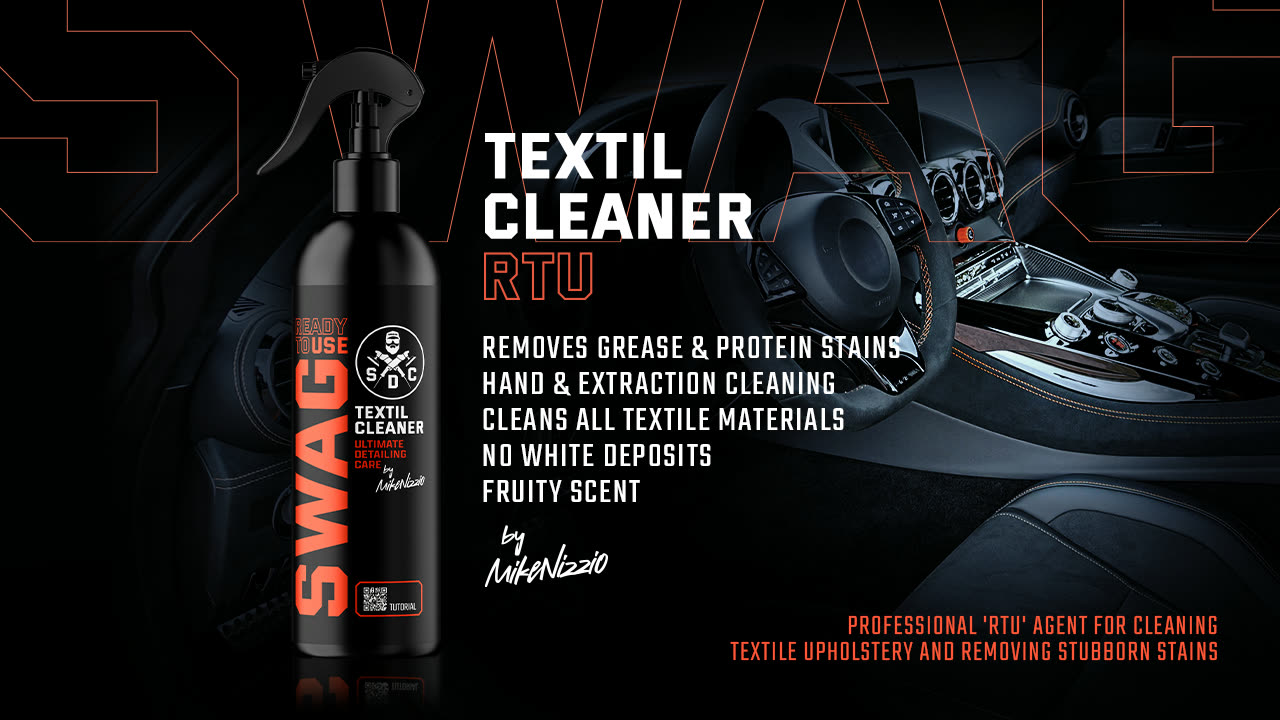
Then use a textile cleaner rather than a bucket of soapy water. I reach for SWAG Textil Bonnet Cleaner RTU for hand work — mist the panel damp rather than soaked, agitate with a soft brush, lift the dissolved dirt out with a clean microfibre. For a neglected car or extractor work, the Textil Cleaner Concentrate Pre-Spray mixes to the label ratio for the job in front of you.
Restraint with liquid is what matters here: every extra spray is water you have to get back out, and returning a car to daily use with damp foam is how the smell restarts a week later. My full upholstery method is in the carpets and floor mats guide.
Pollen filter, vents and hard surfaces
If the smell arrives with the fan, the ventilation system is part of the problem and no amount of carpet cleaning will touch it. Start with the pollen filter — a cheap consumable sitting in the airflow that, after a couple of British winters, is usually grey, damp and full of leaf litter. Replacing it is the highest-value hour in the whole job.
Then wipe the hard surfaces with a balanced-pH cleaner from the interior cleaning range — door cards, sills, footwell plastics, boot trim — because damp leaves a film on plastic that holds smell well. One habit worth adopting afterwards: switch the air-con off for the last few minutes of a drive and leave the fan running, so the evaporator dries instead of sitting wet overnight.
Now — and only now — add fragrance
Once the car is dry, clean and the leak is sorted, fragrance stops being a cover-up and becomes the finish. This is where I wipe the plastics with SWAG Hydrophobic Interior Detailer+ — protected surface, deeper colour, no greasy shine — and only then hang or spray a scent such as Red Cherry Bomb. The full range is in car scents, with more in my guide to choosing a car air freshener.
On ozone generators, since people ask: they do work on smell soaked into soft trim, but only ever after the car is dry, and the car needs airing thoroughly afterwards. Ozone kills a smell; it doesn’t dry a carpet or unblock a drain.
Keeping it away is habit: lift the mats monthly and check underneath, clear leaves from the scuttle channel before autumn, don’t leave wet kit in the boot, change the pollen filter yearly. Ten minutes a month beats a weekend of drying.
Frequently asked questions
Why does my car smell damp after rain?
Because water is getting in and the carpet is holding it — usually blocked scuttle drains at the base of the windscreen, blocked sunroof drain tubes or a tired door seal. Lift the mats after the next heavy shower and press a towel into the carpet; the wet corner tells you where to look.
How do I get rid of a musty smell in my car quickly?
Quickly, you can only reduce it: open everything up, run the heater on fresh air with the fan high for twenty minutes, vacuum thoroughly and leave a moisture absorber in overnight. It only goes permanently once the water source is found and the carpet is dry through.
Can a musty smell come from the air conditioning?
Yes, and it’s one of the most common versions. If the smell is worst in the first thirty seconds after the fan starts, suspect a saturated pollen filter and a damp evaporator rather than the carpets.
How long does a wet car carpet take to dry?
With the underlay soaked, days rather than hours — far longer if the car is shut up between attempts. Extracting the standing water, lifting a corner of the carpet and keeping air moving turns a week into a weekend.
Fix the leak, dry the car, clean the fabric — then finish it. The cleaners I used are in our interior cleaning range; the scent that goes on last is in car scents.