Clean seat belts damp, never wet: pull the belt fully out and lock it there, work a gentle textile cleaner into the webbing with a soft brush, lift the dirt out by drawing the belt through a folded microfibre, and keep it extended until it is completely dry before you let it retract. That is the whole of how to clean car seat straps safely. Almost everything that goes wrong with belts — stiff webbing, a musty pillar, a reel that winds back slowly — comes from soaking them, using something too aggressive, or letting a damp belt retract.
In this guideBelts are safety equipmentWhat never to useStep by stepWhy a wet belt must not retractHolding the belt out to dryWhen it is a garage jobFAQ
A seat belt is safety equipment, not trim
Seat belt webbing is a load-bearing component that has to hold your body weight multiplied several times over in a fraction of a second — so it gets treated with more care than any other fabric in the car. That is not me being dramatic. It is the reason every warning below exists.
The webbing is a tightly woven synthetic strap, stitched at the anchor points and engineered to stretch a controlled amount under load. Anything that attacks those fibres or that stitching damages the belt in a way you cannot see. It will still feel like a belt and still click in. You simply will not know what it is capable of any more. So the rule I work to is simple: the gentlest thing that shifts the dirt, as little liquid as possible, and if the belt is damaged, replace it rather than clean it.
What must never touch seat belt webbing
No bleach, no solvents, no strong degreasers, no washing machine, no steam, no pressure washer. The list I would put on the wall of every valeting bay.
| Never use | Why not |
|---|---|
| Household or oxygen bleach | Attacks fibres and stitching — weakens the belt invisibly, strips the dye |
| Solvents: acetone, white spirit, petrol, brake cleaner | Dissolve fibre finishes; a fume and fire risk in a closed cabin |
| Strong alkaline degreasers or wheel cleaners | Made for metal, not safety textiles. Leave webbing stiff and chalky |
| Steam, boiling water, heat guns | Heat distorts synthetic webbing and softens stitching, permanently |
| Pressure washers | Drive water into the weave and along the belt into the retractor |
| Cutting the belt out to machine wash it | Never. Anchor points are not re-made on a driveway |
| Fabric softener or silicone dressings | Leave a slippery film where you need grip and clean travel |
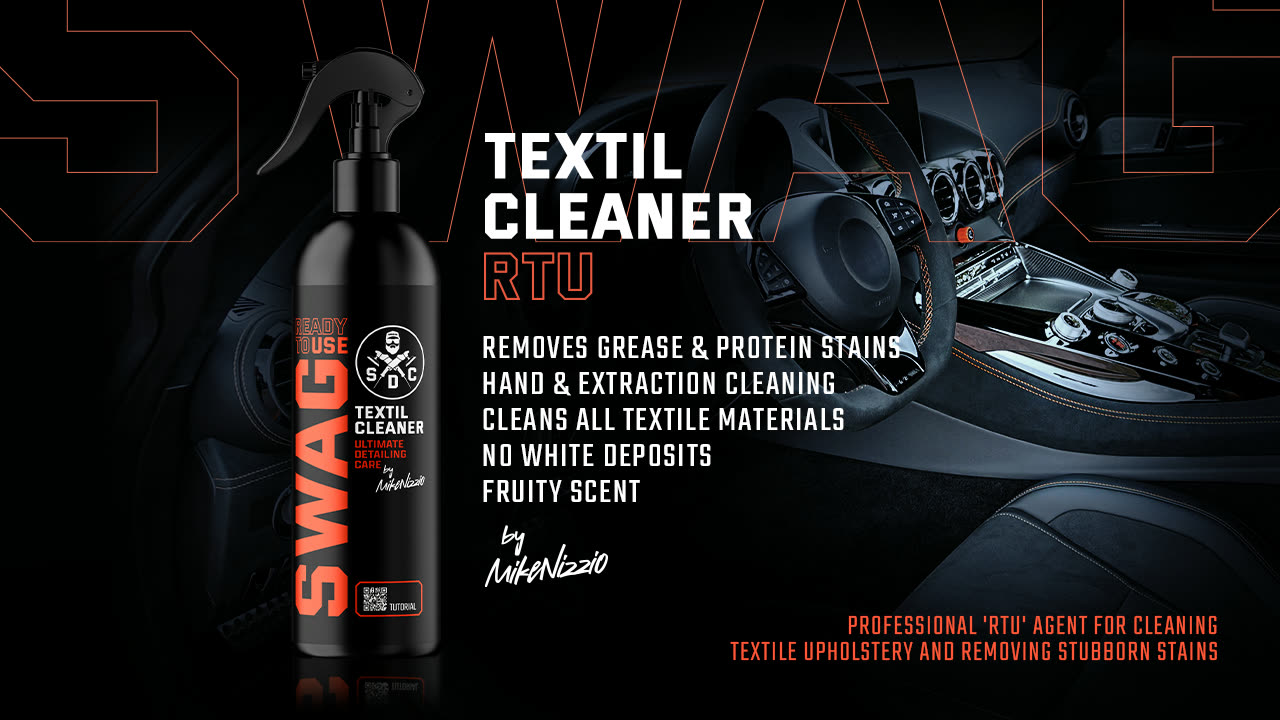
What you want instead is a mild automotive textile cleaner that rinses out of the fibre and dries without residue — a ready-to-use product such as SWAG Textil Bonnet Cleaner RTU. Follow the label; do not improvise something stronger because the belt looks bad.
How to clean car seat straps, step by step
Eight moves, and the two that matter most are the first and the last: lock the belt out before you start, and do not let it back in until it is dry.
- Extend the belt fully and hold it there. Draw it out to the stop and clamp it just above the pillar guide loop so it cannot creep back in.
- Dry first. Vacuum both faces and pass a soft brush over them. Grit in a weave is abrasive; wetting it first grinds it in.
- Test where nobody looks. Try the cleaner near the anchor and check nothing bleeds or stiffens.
- Mist the cloth, not the belt. Damp, never dripping. If liquid runs down the strap you are using too much.
- Work a short section at a time. Twenty or thirty centimetres, soft brush, light overlapping strokes, both faces and the edges. Scrubbing hard only fluffs the weave.
- Draw the belt through a folded microfibre. The step people skip, and the one that removes dirt rather than redistributing it. Refold until the cloth stops colouring.
- Move down the belt and repeat, overlapping sections so you never leave a tide line halfway along.
- Dry it fully extended — doors open, air moving, and give it longer than you think it needs.
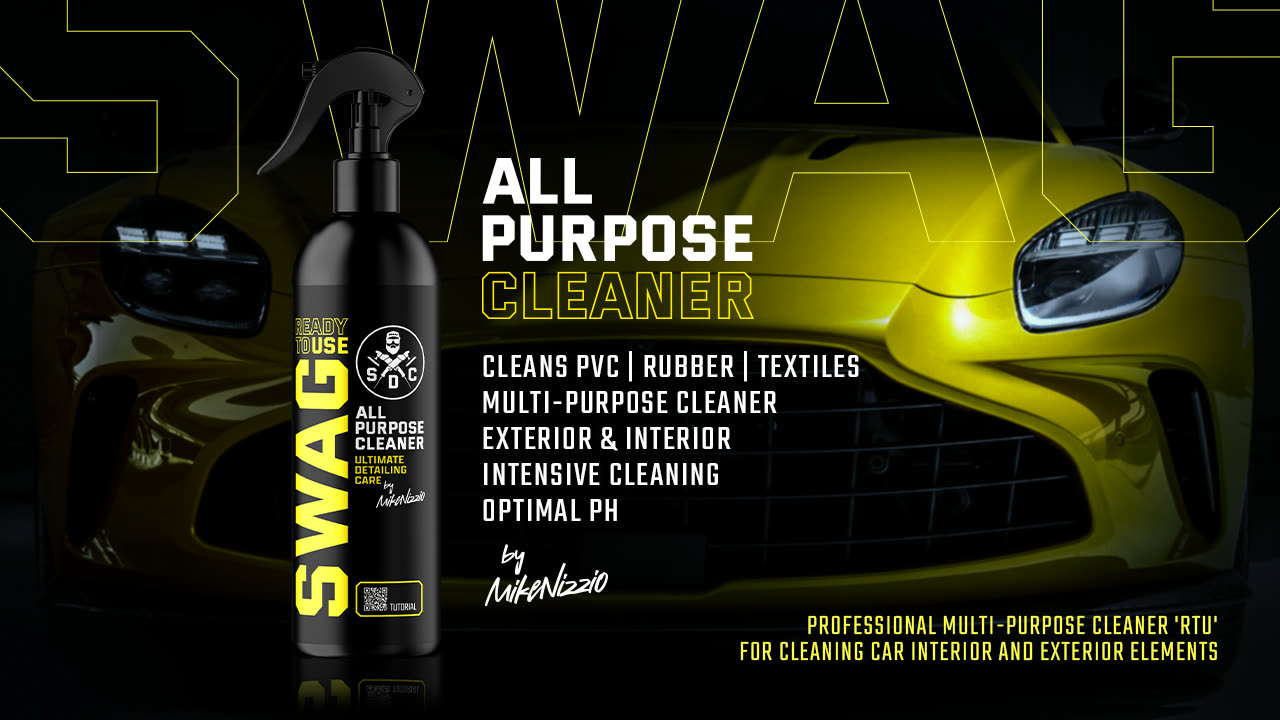
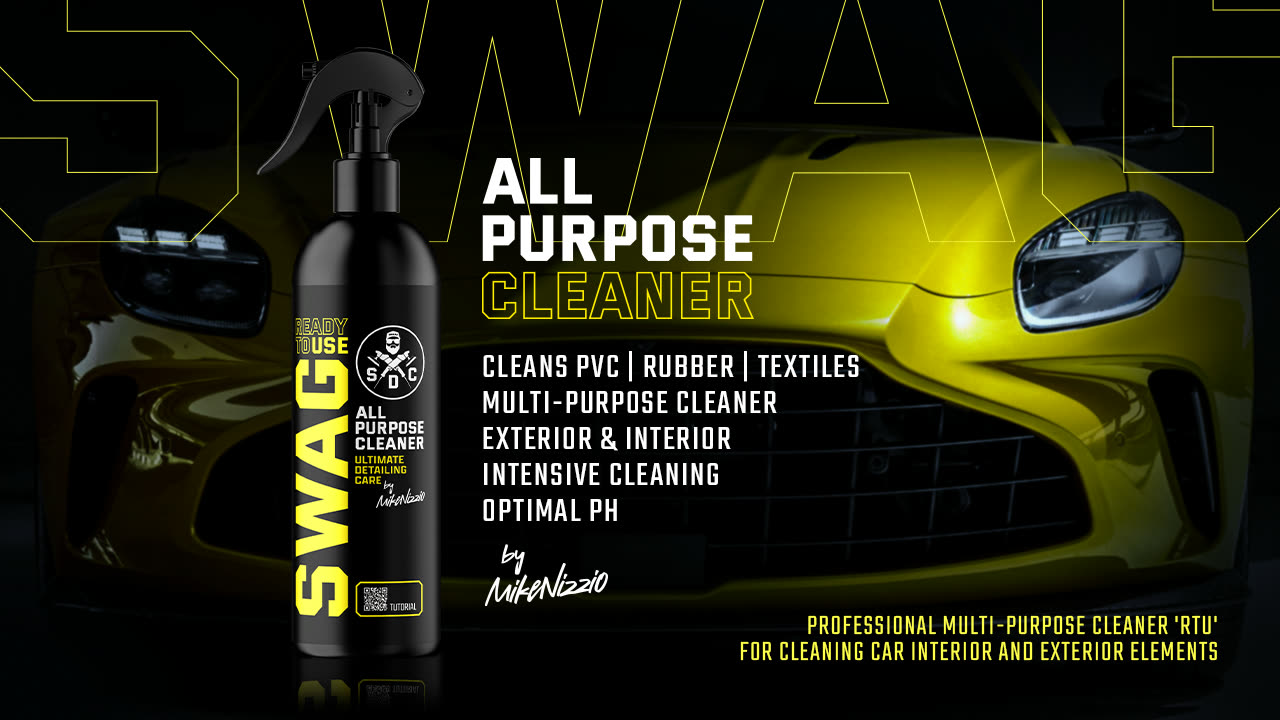
The buckle, the metal tongue and the plastic guide loop are hard surfaces and a different job, so a balanced-pH cleaner like SWAG APC RTU on a cloth or brush is right for them. Keep liquid out of the buckle slot — the release mechanism lives in there.
Why a wet belt must never be allowed to retract
Wind a damp belt back in and you have posted water into a sealed mechanism buried in the B-pillar, with no route out and no airflow. The retractor is a spring-loaded reel that was never designed to be dried out.
What follows, a week or two later, is a smell that seems to come from nowhere, sometimes a belt that winds back more slowly than the one opposite, and in bad cases mildew on the coiled webbing inside the reel where you cannot reach it. If your car already smells musty, work through getting rid of a damp or musty smell in a car — masking damp never lasts.
How to hold the belt out while it dries
Use a clip with broad, flat jaws on the webbing just above the pillar guide, with a folded cloth between clip and belt. A large binder clip or spring clamp is ideal. The cloth matters — anything with teeth can nick the weave, and a nick is exactly what starts a fray. Never wedge the belt in a closed door and never knot it to keep it out; both put a hard crease into the strap.
Give it hours rather than minutes. On a dry day with the doors open, a belt cleaned this way is ready by the time the rest of the interior is finished. In a UK winter, run the blower on fresh air with the heating on. If in any doubt, leave it clipped out overnight — an inconvenient evening beats mould in the reel.
When it is a garage job, not a cleaning job
Cleaning improves how a belt looks. It does nothing for a belt that is damaged, and no product on the market changes that. Stop and book it in if you find any of the following.
- Fraying, cuts, nicks or chewed edges anywhere on the webbing, including the part that sits inside the pillar.
- Stitching that has pulled or come undone at the tongue or an anchor point.
- A belt that will not retract, retracts sluggishly, or does not lock when you tug it sharply.
- A buckle that does not click positively home or releases under a light pull.
- Webbing gone stiff, chalky or patchy after a chemical — that is fibre damage, not soiling.
- Any belt worn in a collision. Belts with pretensioners are single-use items, replaced rather than reused.
Belts are checked at MOT and your garage replaces them as routine. I have never once regretted telling a customer a belt needed replacing rather than cleaning.
Frequently asked questions
Can you use bleach on seat belts?
No. Bleach attacks the synthetic fibres and the stitching that holds the belt together, and the damage is invisible from the outside. It also strips the dye. Use a mild automotive textile cleaner instead.
Can you put seat belts in the washing machine?
No — and never cut a belt out of the car to try. Belts are cleaned in place, extended and locked out, with a damp cloth and a soft brush. Removing and refitting one is a job for someone qualified to torque the anchor points correctly.
How do you get mould off a seat belt?
Surface mould comes off with the method above — repeated gentle cycles rather than one aggressive attempt — followed by long, fully extended drying. If the mould is inside the retractor housing you cannot reach it, and the fix is professional, not a stronger chemical.
Why does my seat belt smell?
Nine times out of ten because it was wet when it retracted, or the cabin is damp and the coiled webbing absorbed it. Clean and dry the belt fully extended, then find the moisture source.
Can I use an all purpose cleaner on seat belt webbing?
I use a mild textile cleaner on the webbing and keep the APC for the buckle, tongue and pillar trim. A balanced-pH APC on a cloth is not the disaster that bleach is, but a dedicated textile product rinses out of the weave more cleanly.
The textile cleaner and the APC I use for this job are both in our interior cleaning range, alongside the rest of the upholstery cleaning line. Damp, gentle, fully dry before it retracts — that is all a seat belt asks of you.