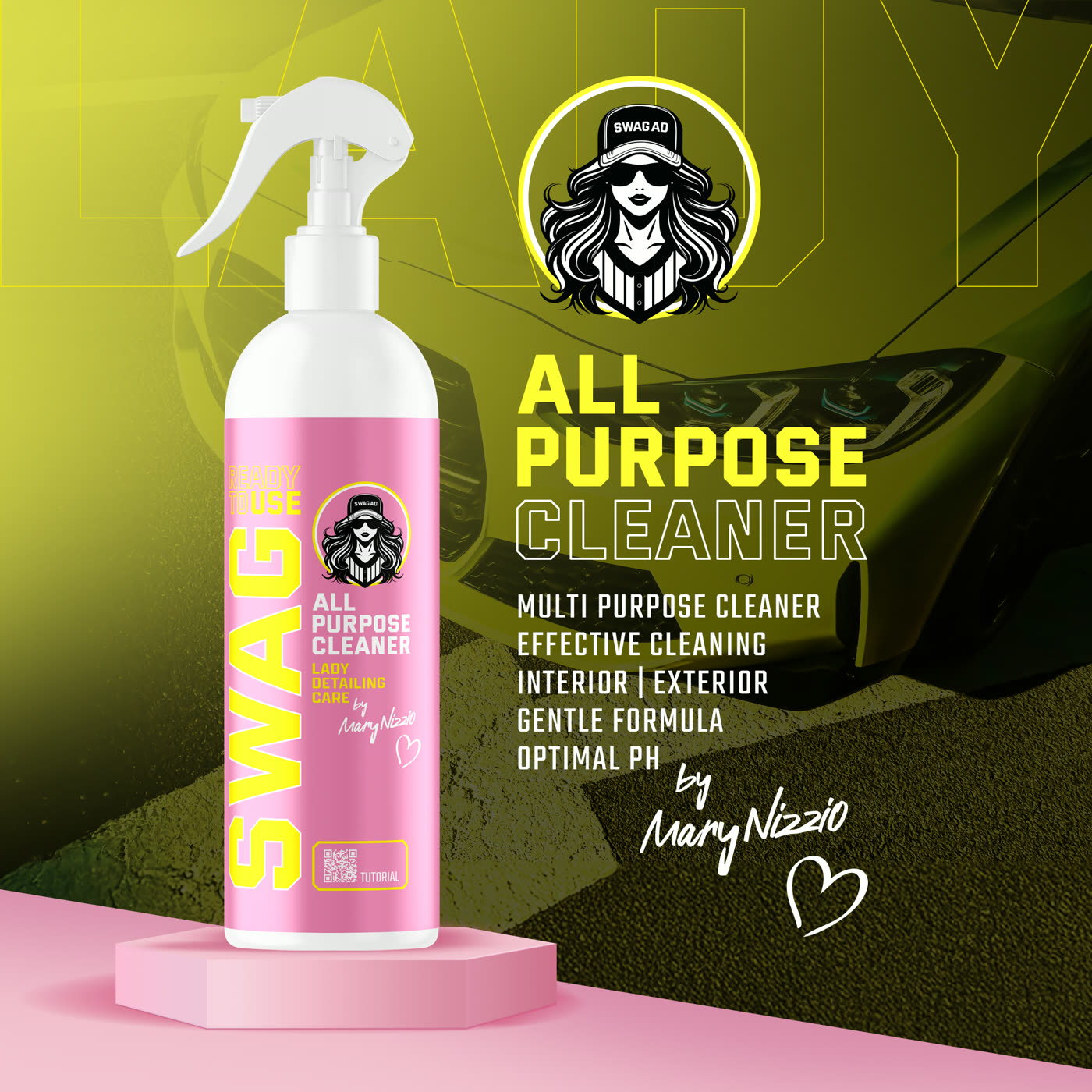
An all purpose cleaner (APC) is the hardest-working product in my studio, and the dilution ratio is what decides whether it cleans brilliantly or causes problems. For everyday maintenance I mix my concentrate at 1:33 — that’s 30 ml per litre of water. For heavily soiled surfaces I go stronger, anywhere from 1:10 to 1:20. Get those two numbers right and one bottle will handle most of the cleaning jobs on a car.
In this guideWhat is an APC used for?The dilution ratios I useHow to mix it properlyCleaning the interiorUsing APC on the exteriorWhich APC should you buy?FAQ
What is an all purpose cleaner used for?
An APC is one product that safely cleans plastics, rubber, synthetic leather, textiles and exterior trim — instead of buying a separate cleaner for each surface. In my studio it goes on plastic dashboards and door cards, trim pieces, rubber seals, boot plastics, door shuts and grimy exterior details.
The one I formulated, Swag APC CONCENTR. GEL+ 1:20, has a balanced pH, which is the whole point: it’s strong enough to lift grime but safe on the delicate surfaces inside a modern car. The gel formula clings instead of running off, so you waste less and it keeps working where you sprayed it.
One habit I’ve kept for 13 years: before using any cleaner on a new material, test it on a hidden spot first. It takes ten seconds and it has saved me more than once.
APC dilution ratios: the numbers I actually use
Two ratios cover almost everything: 1:33 for routine cleaning and 1:10 to 1:20 for heavy soiling. Because it’s a concentrate, you tune the strength to the job — a lightly dusty dashboard does not need the same mix as a boot that carried a muddy dog.
| Job | Ratio | Mix per 1 litre of water |
|---|---|---|
| Routine maintenance — dashboards, trim, light dust and grime | 1:33 | 30 ml of concentrate |
| Heavily soiled surfaces — door shuts, pedals, boot plastics, exterior grime | 1:10 to 1:20 | 100 ml down to 50 ml of concentrate |
| No mixing at all — quick jobs, glovebox bottle | Ready to use | Swag APC RTU, pre-diluted |
Start at the weaker end. You can always mix stronger for a second pass, but you can’t un-scrub a surface you’ve hit with an unnecessarily hot solution.
How to mix APC properly
Shake the bottle before use, measure the concentrate rather than guessing, and mix it with warm water. Warm water helps the concentrate dissolve fully and the solution work at its best — this is one of those small details that separates a proper result from a mediocre one.
Pour the measured amount into a sprayer or a foaming bottle, top up with warm water, and give it a gentle mix. With a foamer you can also choose the foam density you prefer — thicker foam sits nicely on vertical surfaces and upholstery.
Two rules that apply to every session: work in the shade on a cool surface, and never let the product dry on whatever you’re cleaning. Dried cleaner means residue, and residue means doing the job twice.
How I clean a car interior with APC
Apply the APC as foam onto a soft brush — not flooded directly onto the surface — and let it dwell for up to one minute before you agitate. This is the routine I’ve refined on hundreds of interiors in my studio:
- Dispense the foam onto a detailing brush or soft interior brush.
- Spread it gently over the surface — dashboard, door card, trim, seals.
- Wait up to 1 minute so the cleaner separates the dirt from the surface.
- Work the area lightly with the brush, getting into grains and seams.
- Wipe everything dry with a clean microfibre.
Once a surface is clean, protect it. My pattern is APC first, then a coat of Swag INTERIOR DRESSING CREAM SATINE+ — it leaves a natural satin finish and the next clean becomes noticeably easier. Cleaning without protecting is half a job.
Watch me do this start to finish:
Using APC on the exterior
Outside the car I switch from brush to sprayer: apply, spread over the dirty area, wait up to one minute, then rinse with water or wipe with a microfibre. This works on door shuts, fuel filler caps, plastic trim, sills and any greasy grime a shampoo won’t touch.
The same warnings matter even more outdoors: shade only, cool panels only, and don’t let it dry — sun and warm bodywork will flash the product off before it has done its work and leave you with marks to chase.
Which all purpose cleaner should you buy?
Buy a concentrate if you clean regularly, and a ready-to-use bottle if you want zero faff. The concentrate is the economical route — at 1:33 a 500 ml bottle makes over 16 litres of maintenance-strength cleaner, and a 5 L jug is what the professional studios take. The RTU version is pre-mixed at a safe strength, so it’s the one I hand to people who just want to spray and wipe.
Whichever you choose, a balanced pH is non-negotiable for interiors. A cheap, aggressive degreaser will clean fast — and it can also bleach trim, dry out plastics and strip finishes. Everything I use inside a car lives in our Interior Cleaning range for exactly that reason.
Frequently asked questions
What is all purpose cleaner used for?
Cleaning almost every washable surface on a car: plastic dashboards, trim, rubber seals, synthetic leather, textiles, door shuts and exterior plastics. It replaces a shelf of single-purpose products. The dilution ratio, not the product, is what you change between jobs.
Which all purpose cleaner is the best?
For car use, the best APC is a pH-balanced concentrate — it lets you adjust strength from gentle to heavy-duty while staying safe on interior materials. Household all purpose cleaners are formulated for kitchens, not automotive plastics and upholstery, so I keep them out of the car.
Does all purpose cleaner contain bleach?
Some household ones do, which is exactly why I don’t use them inside cars. A dedicated automotive APC like ours relies on a balanced-pH formula rather than harsh actives, so it cleans without bleaching or drying out trim. If in doubt, check the label and always test a hidden spot first.
Can I make a homemade all purpose cleaner?
You can mix washing-up liquid and water, but you get an unknown pH, poor rinsing and residue on plastics. A measured concentrate costs pennies per litre once diluted at 1:33 and behaves predictably — after 13 years of detailing, predictable is what I want on a customer’s interior.
How long should APC dwell before wiping?
Up to one minute. That’s enough time for the cleaner to separate the dirt from the surface without drying on. If the panel is warm or you’re in the sun, don’t extend the dwell — move to shade instead.
Everything I used in this guide — the APC concentrate, the RTU version and the dressings that follow it — lives in our Interior Cleaning range. One concentrate, two dilution ratios, most of the car covered.