A quick detailer is a light spray-on product that refreshes the look of your paintwork between washes — adding gloss, slickness and a short-term protective layer in minutes. It is not a wax, not a polish and not a substitute for washing the car. Used correctly, a quick detailer is the product I reach for more often than any other in daily paint care, and in this guide I’ll show you exactly how and when to use one.
In this guideWhat a quick detailer isQD vs wax vs waterless washHow to use oneWhen to use oneDoes it scratch?Which QD I useFAQ
What is a quick detailer, exactly?
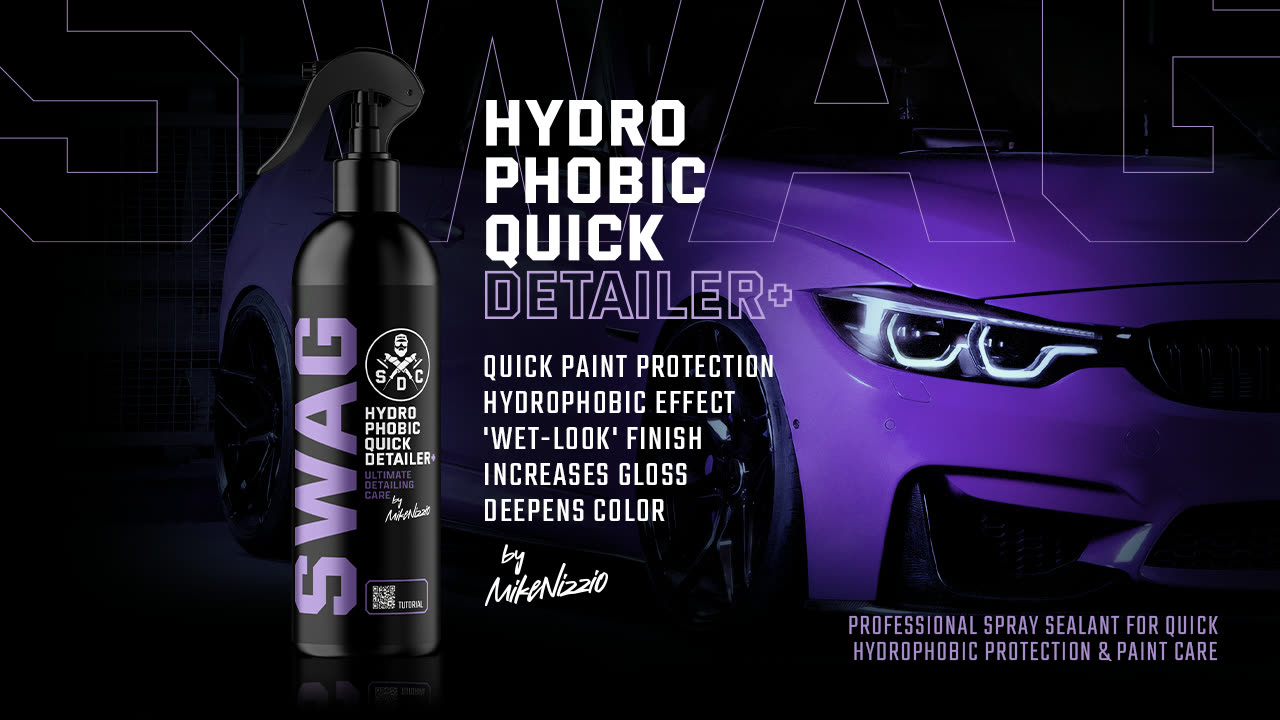
It’s a fast-working maintenance spray built on light polymers that bond briefly to the surface, boosting gloss and water behaviour. In our HYDROPHOBIC QUICK DETAILER+, synthetic polymers produce what detailers call the “wet look” — deeper colour, a glassy surface and a mirror-like shine — while making the panel hydrophobic, so water beads up and rolls off instead of sitting on the paint.
That hydrophobic layer has a practical benefit beyond looks: a surface that repels water also makes it harder for dirt to settle and stick. Your car stays cleaner for longer between washes, and the next wash is easier.
A good quick detailer is also more versatile than people expect. Ours is designed for painted surfaces, metal and plastic elements alike, so you can run it over the whole exterior without swapping products.
Quick detailer vs wax vs waterless wash — what’s the difference?
The difference is the job: a wax protects, a waterless wash cleans, and a quick detailer refreshes. They look similar in the bottle — all sprays, all wiped with microfibre — which is exactly why so many people buy the wrong one.
| Product | Main job | Durability | Use it when… |
|---|---|---|---|
| Quick detailer | Gloss, slickness, light dust removal | Days to weeks | The car is clean-ish and you want it looking sharp |
| Spray wax / sealant | Durable protection | Weeks to months | You’ve just washed and want lasting protection |
| Waterless wash | Cleaning light dirt without a hose | — | The car is dirty and you can’t do a proper wash |
The formats blur at the edges — our BASIC QUICK WAX DETAILER deliberately sits between a QD and a spray wax, adding depth and slickness with a hydrophobic effect in one simple product. If you want to see how a dedicated spray wax behaves compared with a quick detailer, watch me apply one start to finish:
How do you use a quick detailer?
Spray, spread, wait a minute, buff — on a clean, cool panel. The technique matters more than people think, so here is the exact routine from my studio:
1. Prepare the surface. The car must be clean and cool. Work in the shade and never apply a quick detailer to hot paintwork — the product flashes off before it can level, and you end up chasing streaks.
2. Apply. Shake the bottle first. Spray directly onto the panel or onto a microfibre applicator, then spread the product evenly across the surface.
3. Wait. Leave it on the surface for about 1 minute so the active ingredients can do their work. This is the step everyone skips, and it’s the difference between a slick finish and a smeary one.
4. Buff. Polish off with a clean, high-GSM microfibre. If the cloth starts dragging or the residue fights back, swap to a fresh microfibre rather than pushing harder.
5. Repeat panel by panel around the car, and enjoy the wet look at the end.
When should you reach for a quick detailer?
After every wash, and between washes whenever the car needs a lift. These are the four situations where a QD earns its place on my shelf:
After a hand wash — as the finishing step, adding protection and emphasising the gloss you just worked for. After a touchless or pressure wash — extending that just-cleaned effect and the depth of colour. Day to day — quickly refreshing the car’s appearance and removing light dust or fingerprints. Before shows and meets — for that final, perfect presentation of the paint.
Notice what’s not on the list: a genuinely dirty car. A quick detailer is maintenance, not a wash.
Does quick detailer cause scratches?
Not when it’s used on light dust with the right technique — the lubrication is what keeps the process safe. The polymers in a quick detailer let the microfibre glide over the surface instead of grinding particles into it, which is why a QD supports safe hand care and reduces the risk of marring compared with wiping paint dry.
But lubrication has limits. If the panel is coated in visible grime, road film or winter salt, wiping it with any spray-and-cloth product means dragging grit across your clearcoat. That car needs a proper wash first — the quick detailer comes afterwards.
Use a clean, plush microfibre, fold it to a fresh face regularly, and let the product do the work.
Which quick detailer should you choose?
Match the QD to what’s on your paint. The pattern I use in the studio: HYDROPHOBIC QUICK DETAILER+ is the everyday workhorse — wet look, strong water beading, safe on paint, metal and plastics, with a fruity scent that makes the job pleasant. For cars wearing a ceramic coating, CERAMIC SiO2 PROTECT QUICK DETAILER tops up the coating’s slickness and gloss with an SiO2-based formula.
On a budget, or just starting out? The BASIC QUICK WAX DETAILER covers maintenance, hydrophobics and paint depth in one bottle. All three live in our paint maintenance range.
Frequently asked questions
What is car detailer spray?
“Detailer spray” and “quick detailer” are the same thing: a light maintenance spray that adds gloss and slickness to paintwork and helps remove light dust safely. It sits at the mild end of the product spectrum — stronger than nothing, gentler than a wax or sealant.
Does quick detailer remove water spots?
It removes fresh water marks — droplets that have dried recently and left a light residue. Baked-in mineral spots that have etched the surface are beyond any spray; those need a dedicated water spot remover or polishing to correct properly.
Can a quick detailer replace washing the car?
No. A quick detailer handles light dust and fingerprints on an otherwise clean car. Actual dirt — road film, mud, salt — must be washed off with water and shampoo first, otherwise you risk scratching the paint no matter how good the QD is.
Can you use a quick detailer on plastic and glass?
Our HYDROPHOBIC QUICK DETAILER+ is designed for painted, metal and plastic exterior elements, so gloss trim and painted plastics are fine. On glass I’d use a dedicated glass cleaner instead — polymer films on a windscreen can smear in the wipers’ path.
Everything I used in this guide lives in our paint maintenance range — the quiet products that keep a car looking freshly detailed between the big jobs.