Cream and white leather is not more delicate than dark leather — it just hides nothing, which changes how you have to look after it. The same body oils, denim dye and grime land on a black interior and disappear. On light leather they build into grey bolsters, blue-tinged side panels and a driver’s seat that looks a decade older than the passenger’s. The good news is that the finish itself is the same coated leather found in almost every modern car, so the products are the same. What changes is the schedule, the pressure you use, and how quickly you deal with dye transfer.
In this guideWhat light leather actually showsWhy bolsters go grey firstDenim dye transferThe cleaning methodPerforated and ventilated seatsWhy conditioning matters more hereThe maintenance scheduleFAQ
You are cleaning a coating, not a hide
Almost all light-coloured automotive leather is pigmented and sealed — the cream colour you see is the coating, not the leather underneath.
That is genuinely good news. It means dirt sits on a sealed surface rather than soaking into a hide, so most marks are removable with a gentle cleaner and patience. It also means the thing you must protect is the coating: strip it, dry it out or scrub through it and you get shine loss, then colour loss, then cracking.
It also explains why light leather looks bad faster without actually being worse. The soiling on a black seat is identical; you simply cannot see it. So owners of dark interiors clean twice a year and get away with it, while cream leather punishes exactly the same neglect visibly. Background on the finish itself is in what makes a good leather cleaner.
Why the bolsters go first
The driver’s outer bolster takes every entry and exit, and that is friction plus denim plus body oil in one small area.
Look at any light interior with mileage and the pattern is always the same: outer bolster of the driver’s seat worst, then the seat base edge, then the steering wheel, then the door armrest. These are contact points, and contact deposits oils that then hold dirt.
Which leads to the single most useful habit for light leather: clean the contact points often and lightly, and the rest of the seat rarely. A five-minute wipe of the bolsters every couple of weeks does more than a deep clean twice a year, and it never lets the grime build to the point where you need pressure to remove it.
Denim dye transfer: the light leather problem
Blue-grey shading on the seat base and bolsters is almost always dye from jeans, and it comes out far more easily when it is fresh.
Indigo dye is not permanently fixed in denim, especially in newer or darker jeans. Friction plus warmth plus a little moisture — which is exactly what a seat under a driver provides — moves it onto the leather surface. On black seats this is invisible. On cream it is the number one complaint.
Caught early, it usually lifts with a leather cleaner and a soft brush over two or three gentle passes. Left for months it migrates into the grain texture and the fine cracks of the coating, and at that point complete removal may not be realistic. Forcing it with pressure or a harsh product does more damage than the stain: you can polish the sheen off the coating and end up with a shiny patch that looks worse than the shading did.
Two or three light passes with drying time between them beats one determined attempt, every time.
The method
- Vacuum first, especially the seams and the gap between base and backrest. Grit in a seam turns a wipe into fine abrasion.
- Test on a hidden area — the outer face of the backrest low down, or under the seat base. Do this even with a product you have used before, because light leather is where any reaction shows.
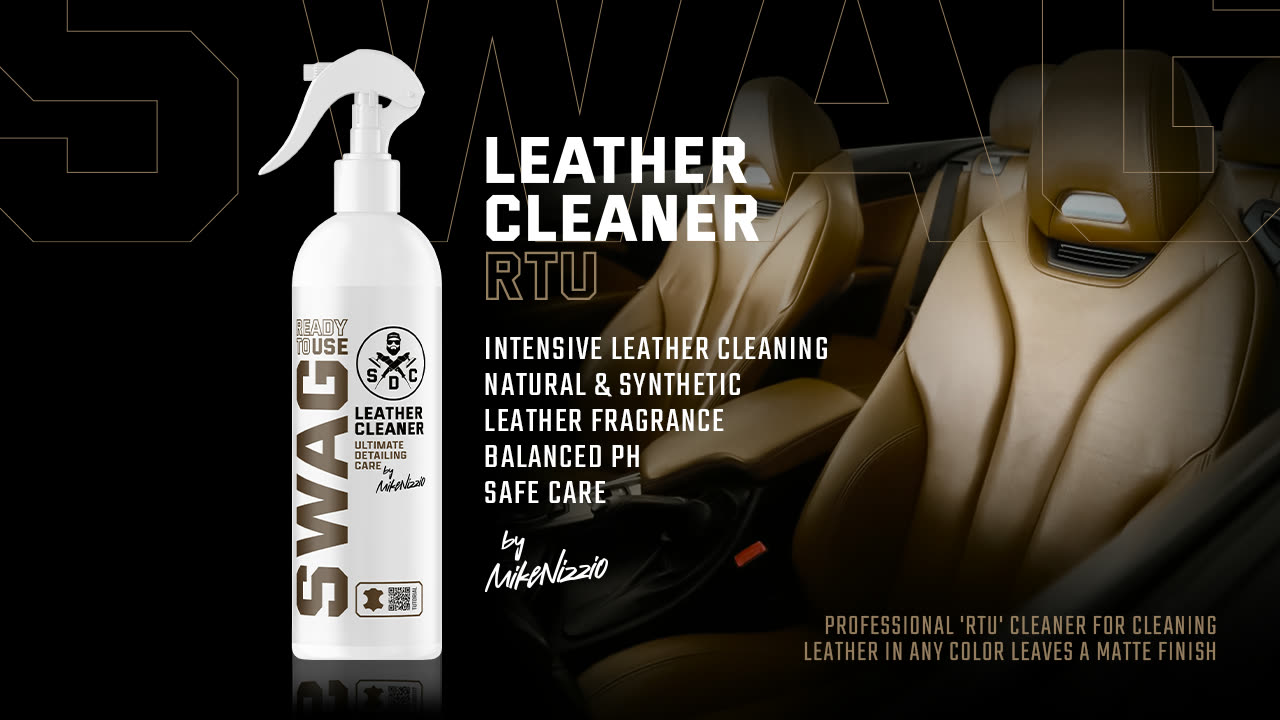
- Product onto a soft brush or cloth, never sprayed onto the seat. A ready-to-use cleaner such as Swag INTENSIVE LEATHER CLEANER RTU removes any mixing error from the equation.
- Work a small section gently with a soft brush, in light circles, letting the foam do the lifting.
- Lift immediately with a clean, damp microfibre — folding to a fresh face constantly. On cream leather you can literally watch the cloth go grey, which tells you it is working.
- Repeat on stubborn areas rather than pressing harder.
- Condition once dry. Non-negotiable on light leather — see below.
If you clean leather regularly, a concentrate such as Swag LEATHER CLEANER CONC. GEL+ costs far less per use, mixed at the ratio on the label. For light leather the ability to mix it weaker for routine maintenance is genuinely useful.
Perforated and ventilated seats
The holes lead straight into the foam, and light leather is often exactly the specification that comes with ventilation.
Keep the product on the cloth and never flood a perforated panel. Liquid that goes through the holes sits in the foam, and foam that stays damp smells within days — the same mechanism covered in the damp and musty smell guide.
Work in small sections, use a barely damp brush, and lift straight away. If a hole has grime around its rim, a soft detailing brush used dry will often flick it out before you introduce any moisture at all.
Conditioning matters more on light leather
Because you clean light leather more often, you are working the coating more often — and conditioning is what puts that back.
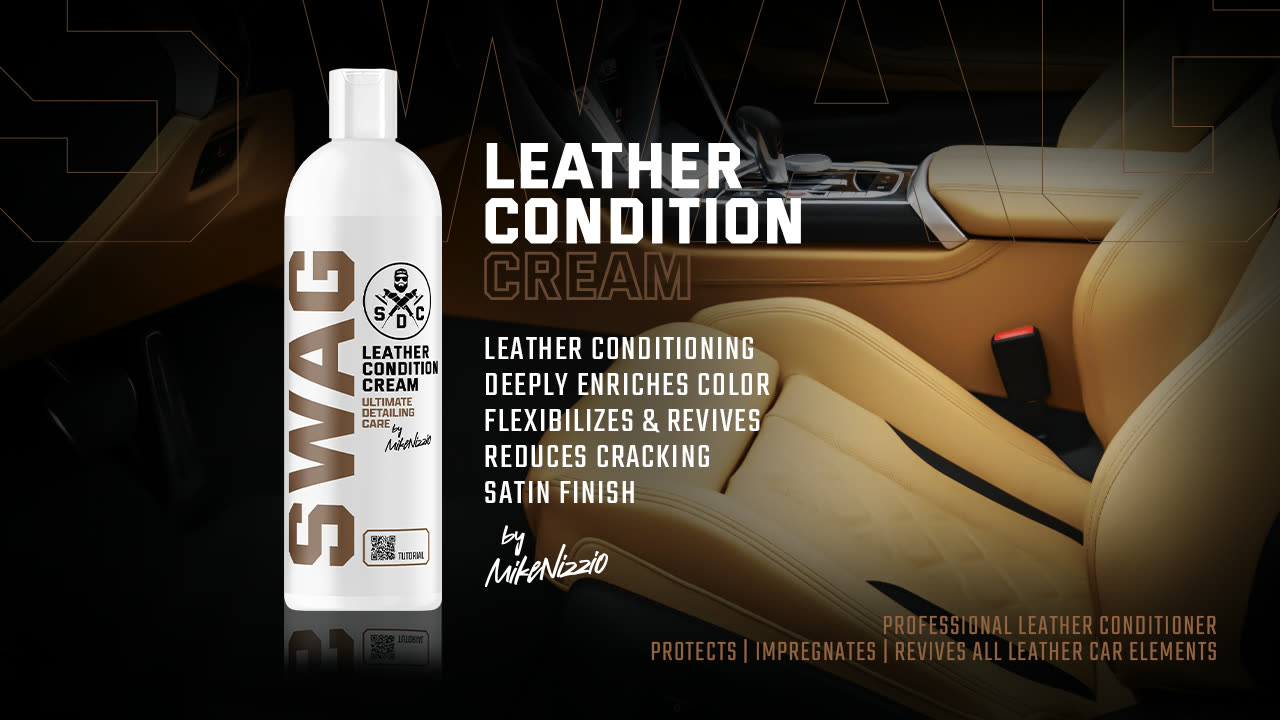
Swag LEATHER CONDITIONER CREAM V.2 after every clean is the routine. Apply thinly, work it in, and buff off the excess — a greasy finish attracts dirt and makes the next clean harder, so less is genuinely more.
For seats that face a lot of sun or a lot of use, an impregnation such as Swag LEATHER HYDRO PROTECT+ adds a barrier that makes dye transfer and spills easier to remove later. One caveat worth knowing on cream leather: impregnations of this type deepen the grain tone slightly, so test on a hidden section and decide whether you like the result before doing a whole seat. The reasoning behind conditioning is in do you need a leather conditioner, and the long game is in how to stop leather seats cracking.
A realistic schedule
| Task | How often | Why |
|---|---|---|
| Wipe contact points | Every couple of weeks | Stops build-up before it needs pressure |
| Full clean and condition | Every couple of months | Catches what wiping misses |
| Deal with dye transfer | As soon as you see it | Fresh transfer lifts; old transfer may not |
| Reapply impregnation | A few times a year | Keeps the barrier working |
FAQ
Why do my cream seats look dirty again within weeks?
Because the contact points are re-soiling, not the whole seat. Body oils transfer continuously and light leather shows them immediately. The fix is not stronger cleaning — it is more frequent, lighter wiping of the bolsters, wheel and armrest.
Can I use a magic eraser or melamine sponge on white leather?
No. Melamine works by being finely abrasive, so on a pigmented coating it removes sheen and eventually colour. It looks like it worked brilliantly, then leaves a dull patch that catches the light differently and cannot be put back.
How do I stop denim dye transferring in the first place?
You cannot stop it entirely if you wear jeans, but you can make it easier to remove. A leather impregnation gives the dye a barrier to sit on rather than a bare coating to soak into, and washing new dark jeans a few times before wearing them in the car reduces how much dye is loose.
Are white seats harder to keep clean than black?
They get exactly as dirty; they just show it. In practice light leather is often in better condition long-term, because owners are forced to clean it regularly and regular gentle cleaning is far kinder to the coating than occasional heavy cleaning.
The dye transfer will not come out. Have I damaged the seat?
Probably not — old transfer that has migrated into the grain can be genuinely permanent without professional recolouring, but that is a cosmetic limit rather than damage. What would be damage is what people do next: scrubbing hard or reaching for something aggressive. If two or three gentle passes have not shifted it, stop and accept it, or get a specialist opinion.
Cleaners sit in Leather Cleaning and the protection step lives in Leather Conditioning.