To shampoo car seats without soaking them, you mist the cleaner onto the fabric, work it into the fibres with a brush, and lift it straight back out with a dry microfibre or an extractor — the surface should never be wetter than damp. Water that reaches the foam underneath takes days to come back out, and while it sits there it grows the musty smell you were trying to remove. Moisture control isn’t one step of this job. It is the job.
In this guideWhy soaking is the mistake that ruins the jobWhat you need before you startHow to shampoo car seats, step by stepGetting the moisture back outDrying and ventilating properlyHand cleaning vs a wet extractorThe five mistakes that soak a seatFAQ
Why soaking is the mistake that ruins the job
A car seat isn’t a piece of fabric — it’s a thick block of open-cell foam with fabric stretched over it, and that foam behaves like a sponge you can’t wring out. Anything you put on the surface and don’t lift straight back off goes downwards, and the wet part then sits at the bottom, furthest from any air.
The consequences are predictable: days of drying rather than hours, then a sour smell on the first warm morning as bacteria feed on the dirt you dissolved and pushed down instead of removing. That’s where a damp or musty smell in a car comes from.
And as the foam dries it wicks moisture back upwards, carrying that dirt with it and depositing it at the surface as a ring. That’s the “stain came back” phenomenon — it never left, it just went for a walk and came home.
What you need before you start
Four things: a vacuum, a dedicated textile cleaner, a soft upholstery brush and more clean microfibre towels than you think. Notice what isn’t on the list — a bucket, a hose and a bottle of washing-up liquid.
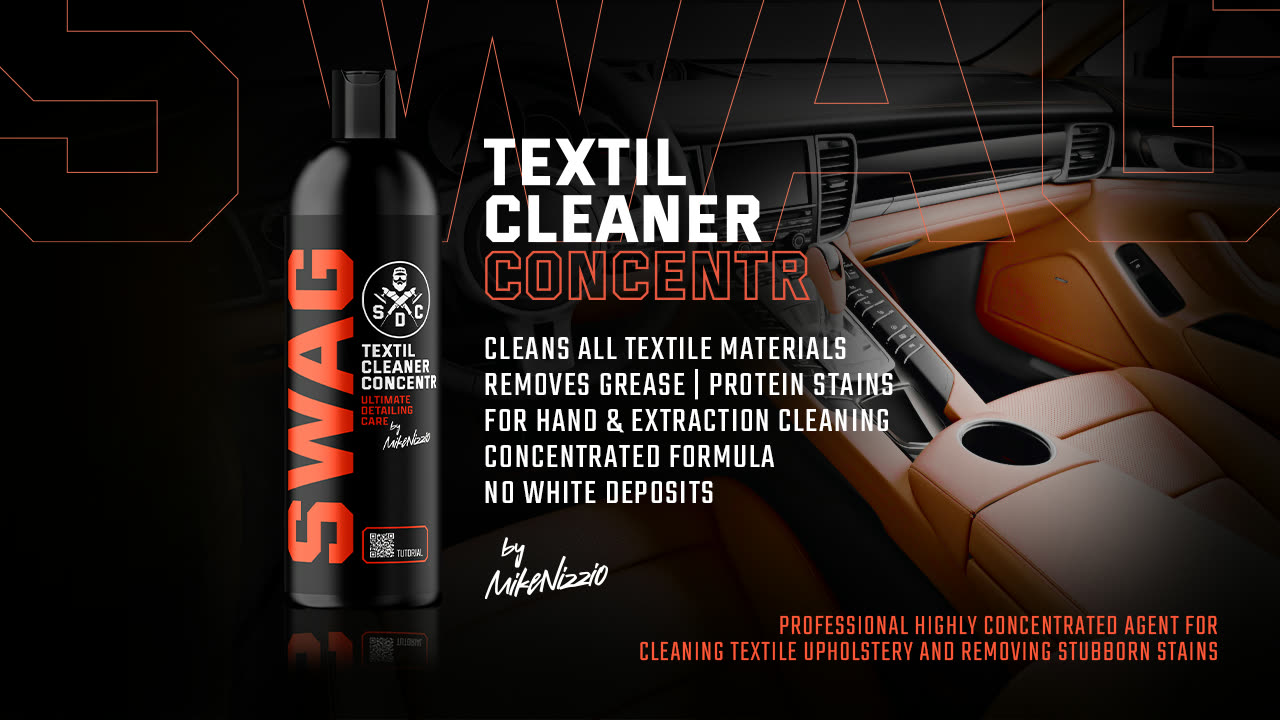
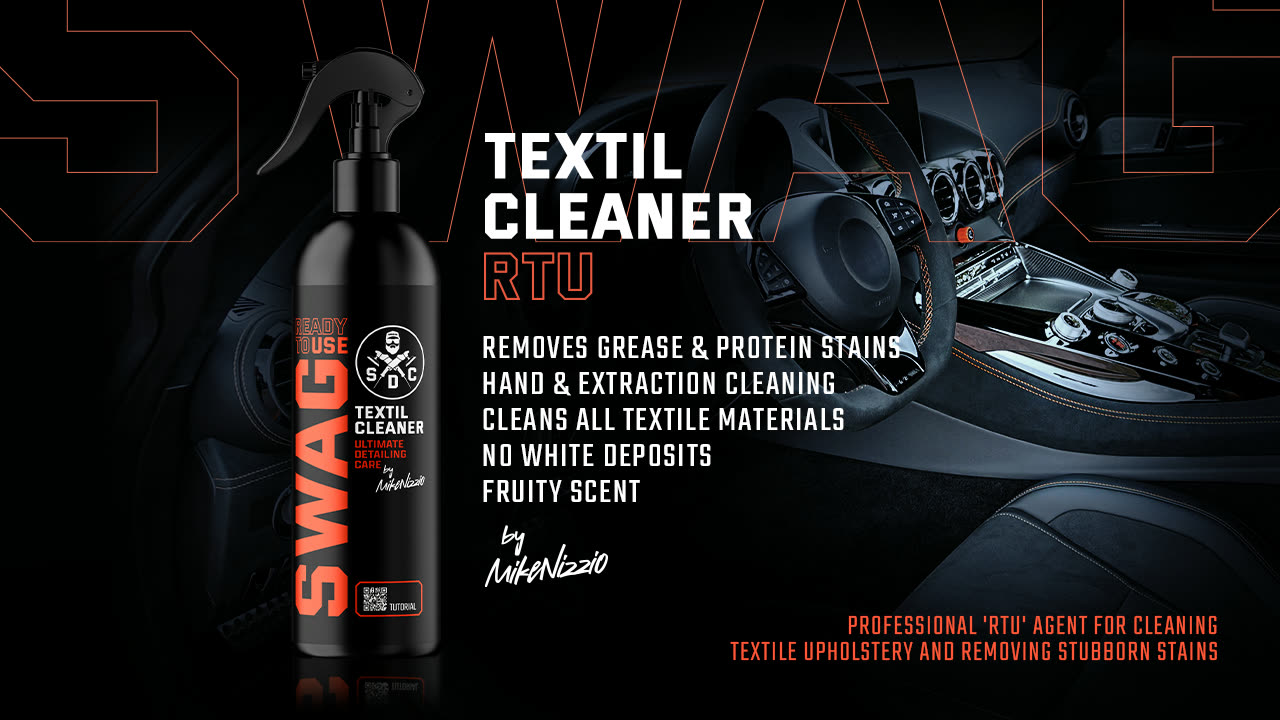
The cleaner must be made for automotive textiles and must dry without white residue — anything that dries chalky in a seat shows every time the sun hits it. I use TEXTIL CLEANER CONCENTR PRE-SPRAY V.2.1 mixed to the ratio on the label, and TEXTIL BONNET CLEANER RTU V.2.1 when I want to start without measuring anything.
Soft bristles carry the cleaner into the weave; a stiff brush frays the fibre so the patch ends up shining differently to the rest of the seat. And keep the towels coming — a saturated microfibre stops absorbing and starts redistributing, which is the same as adding water.
How to shampoo car seats, step by step
Work one panel at a time, keep the fabric damp rather than wet, and finish each panel before moving on. Doing the whole seat in stages is how the first section dries with a tide mark while you’re still on the last.
- Vacuum thoroughly first — surface, seams, the gap between base and backrest, under the seat. Wet cleaner on loose dust makes grey slurry that spreads.
- Test in a hidden spot — under the seat base or behind the backrest — before anything visible gets touched.
- Mist the cleaner over one panel. The fabric should darken evenly, not glisten. Visible liquid sitting on the surface is already too much.
- Give it a moment to dwell. This is what replaces scrubbing: the chemistry lifts dirt off the fibre while you wait. Follow the label.
- Agitate gently with the brush. Short overlapping strokes, no weight behind them. You’re working the product into the fibres, not driving it into the foam.
- Lift it straight back out with a clean microfibre folded into quarters, pressed and drawn across the panel, turning to a fresh face as each loads with dirt.
- Repeat lightly if it needs it. Two gentle passes beat one heavy one — and use less water in total.
- Move to the next panel until the whole seat is done seam to seam, so you don’t leave a clean patch on a tired seat.
For a specific mark rather than general grime the approach changes — that’s covered in how to remove stains from car seats. Here’s a full interior in progress:
Getting the moisture back out
Every drop you put on has to come back off, and that removal is what actually cleans the seat — the cleaner only loosens the dirt. Two ways to do it, depending on what you own.
Blotting by hand is what most people should do. Press the folded towel down and hold for a second rather than wiping — pressure transfers moisture, dragging spreads it. When a towel comes back only faintly grey, that panel is done.
A wet extractor does it better, because suction pulls from below the surface rather than off it. The rule is still restraint: light on the spray, and finish each panel with two or three dry passes with the water off. Those dry passes are where the moisture actually leaves.
Drying and ventilating properly
Airflow dries a car interior; heat alone just moves moisture from the seats to the windows and back. Plan the job so the car can stand open afterwards — a humid evening with the doors shut is the worst possible finish.
Open all four doors, or the boot and two doors if the weather is uncertain. A fan pointed into the cabin does more than anything else, and a domestic pedestal fan is fine. If you have to shut the car, run the heater on fresh air rather than recirculate first.
The test for “dry” isn’t how the fabric feels — it’s how it feels under pressure. Press a folded dry towel into the seat base with your weight behind it; any dampness means the foam is still holding water. Done properly, seats are usable in a few hours. Done wrong, you’re waiting days.
Hand cleaning vs a wet extractor
Hand cleaning is enough for a normally grubby seat; an extractor earns its place when dirt has been ground into the foam over years. Neither is safer by default — an extractor used carelessly puts far more water in than a careful hand clean ever will.
| Hand cleaning | Wet extractor | |
|---|---|---|
| Best for | Routine grime, refreshing a tidy car, one-off marks | Neglected interiors, pet and biological messes, deep soiling |
| Water introduced | Very little, and entirely under your control | More — but pulled back out if you use it properly |
| Typical drying time | Hours with the doors open | Hours if extracted dry; days if over-wetted |
| Main risk | Not lifting enough dirt out, so it wicks back | Getting carried away with the trigger |
One material warning. Suede and Alcantara don’t take this treatment — far less moisture, no hard brushing, a different product entirely, as in cleaning suede and Alcantara seats. And leather never gets shampooed at all.
The five mistakes that soak a seat
Every soaked seat I’ve been called out to fix came from one of these five.
- Spraying until the fabric glistens. Damp is the target; visible liquid is past it.
- A bucket of soapy water and a sponge. A sponge holds far more water than a seat can take, and household soap dries sticky and re-attracts dirt.
- Scrubbing instead of dwelling. Pressure drives moisture and dirt downwards; dwell time and gentle agitation lift them up.
- Reusing a wet microfibre, which puts water and dirt straight back into the panel you just cleaned.
- Shutting the car straight afterwards. Cleaning in the evening and closing it up overnight is how a good clean becomes a smell problem.
A spotless seat above a dirty carpet doesn’t look clean either — the carpets and floor mats guide works to the same restraint with liquid.
Frequently asked questions
How long do car seats take to dry after shampooing?
A few hours with the doors open and air moving, if you kept the fabric damp rather than wet. If water reached the foam, expect a day or more — and considerably longer in a closed car, which is exactly when musty smells start.
Can I use carpet shampoo or washing-up liquid on car seats?
I wouldn’t. Household products leave residue that dries sticky, attracts dirt straight back to the patch you cleaned and often shows as white marks on dark fabric. An automotive textile cleaner is formulated to rinse out of the fibre and dry clean.
Why does my seat smell after cleaning it?
Because moisture is still in the foam, and bacteria are feeding on dirt that was pushed down rather than lifted out. Get air moving through the car until a towel pressed hard into the base comes back completely dry, and clean it again more gently if the smell persists.
Should I clean seats with heated elements or airbags in them?
Yes, but this is the strongest argument of all for keeping the fabric merely damp. Modern seats contain heaters, sensors and side airbag modules, and none of them want standing water. Light misting and thorough blotting keeps everything well away from the electronics.
Light on the liquid, patient with the dwell, thorough with the towels. The textile cleaners I use for every seat in this guide live in our Upholstery Cleaning range.