Those tiny orange or rust-coloured specks in your paint are iron fallout: microscopic metal particles that have embedded themselves in the clear coat and started to corrode. They come off wheels, railways and industry, they are far too small to see landing, and no amount of washing will shift them — which is why an iron fallout remover exists as a separate step. Spray one on and the panel appears to bleed purple. That colour is the point of the whole thing, and below I’ll explain exactly what it’s telling you.
In this guideWhat iron fallout actually isWhere it comes fromWhy leaving it costs you clear coatThe bag test: do you actually have it?What an iron fallout remover does — and why it bleedsWhere it fits in the decontamination orderHonest safety notesFAQ
What iron fallout actually is
Fallout is hot metal dust that landed on your car, sank into the clear coat while it was still warm, and is now slowly rusting in place. Each particle is smaller than a grain of sand — the orange speck you can see isn’t the particle, it’s the corrosion halo around it.
This is why it’s so easy to miss. On a dark car you barely notice anything until you get up close in good light; on white and silver it stands out badly, which is why owners of pale cars are usually the ones who go looking for an explanation. Same contamination, different visibility.
And it is genuinely embedded, not sitting on top — which is why a car can come out of a careful two-bucket wash still covered in specks. The paint isn’t stained, it’s contaminated.
Where it comes from: brakes, railways and industry
Three sources account for almost everything I see on UK cars, and you can usually tell which one you’ve got from where the specks are.
Brake dust is the everyday one. Every time you brake, the pads shed iron particles at high temperature — onto your wheels first and the surrounding bodywork second. It’s why wheels are always the worst-affected part of any car and the lower rear quarters come next.
Rail dust is the one people don’t expect. Trains generate enormous quantities of iron particles, so cars parked near a line — or transported by rail from the factory — collect it evenly across horizontal panels. Industrial fallout is the third: foundries, steelworks, welding and construction. It’s localised, so park in the wrong industrial estate for a week and you’ll pick up more than in a year of ordinary driving.
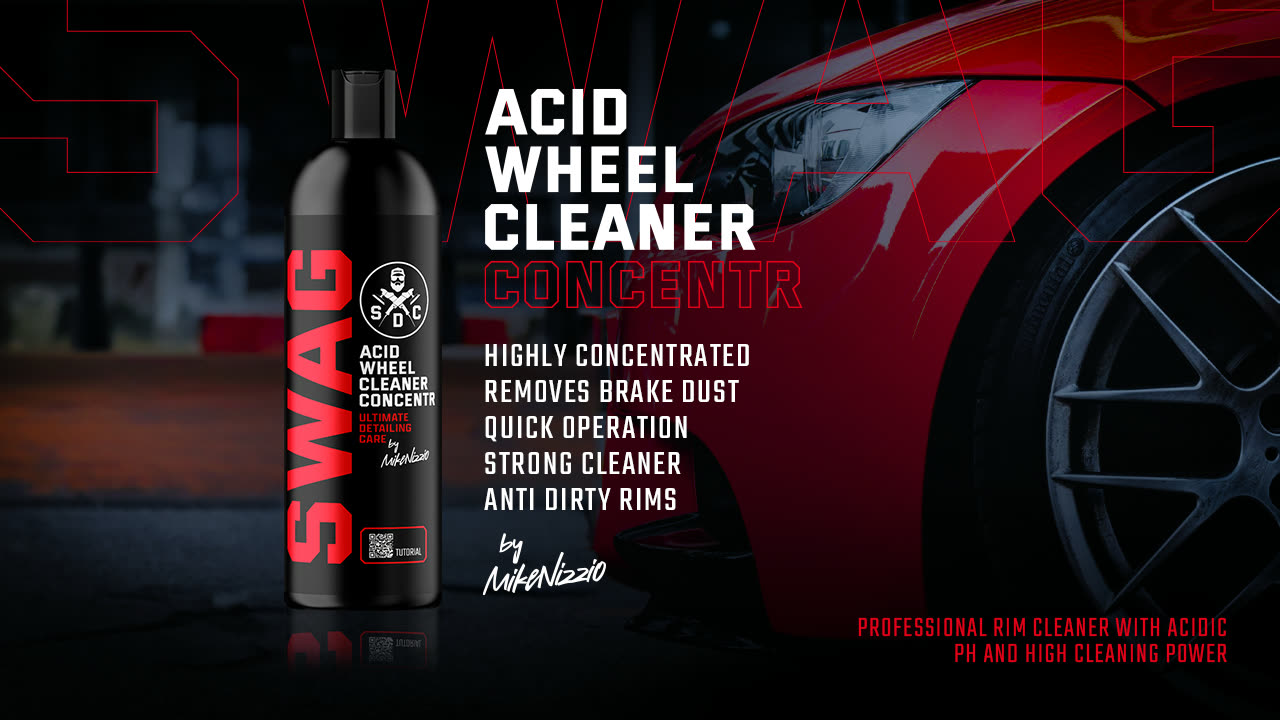
A word on wheels. Where brake dust has been baked on for years a pH-neutral fallout remover may not be enough, and something like ACID WHEEL CLEANER 1:20 is the honest answer — but be clear what that is: an acidic concentrate for wheels, diluted to the label ratio, never for paintwork and not for every wheel finish. Test an inconspicuous area first. The full routine is in how to clean alloy wheels.
Why leaving it costs you clear coat
An embedded iron particle doesn’t sit still — it corrodes, and corrosion expands. As the rust grows it forces outwards into the surrounding lacquer, widening its own crater. That’s why fallout gets worse rather than staying the same.
Water makes it faster. Every rain shower and damp night feeds the reaction, and in a British climate that’s most of the year. Add road salt in winter and it accelerates again, because salty water is a far better electrolyte than plain water.
Catch it early and it dissolves out chemically, leaving paint that’s perfectly fine underneath. Leave it for years and you’re no longer removing contamination, you’re polishing out pitting — and polishing costs clear coat you can’t replace. There’s a second consequence too: fallout ruins protection. Wax or ceramic applied over embedded iron seals the problem in and bonds badly around each particle, so it fails early in exactly the spots you least want.
The bag test: do you actually have it?
Wash and dry the car, put your hand inside a thin sandwich bag, and glide your fingertips over the bonnet. The bag turns your fingers into a sensor. Clean paint feels like glass; contaminated paint feels like fine sandpaper.
It’s the oldest trick in detailing and still the most useful, because bare fingers simply can’t detect particles that small. Test the bonnet, roof and boot lid first — horizontal panels collect the most — then the lower rear quarters behind the wheels. If those feel gritty on a freshly washed car you have bonded contamination, and washing harder will never fix it.
What an iron fallout remover does — and why it bleeds purple
A fallout remover contains a compound that reacts with metallic iron, dissolving the particle into a soluble form that rinses away — and the by-product of that reaction is deep purple-red. The colour is an indicator, not a dye added for show.
That makes it the most useful diagnostic tool in detailing. Spray a colourless liquid onto a panel and watch: nothing means no iron, scattered purple dots mean scattered particles, and a panel running red in streaks means heavy contamination.
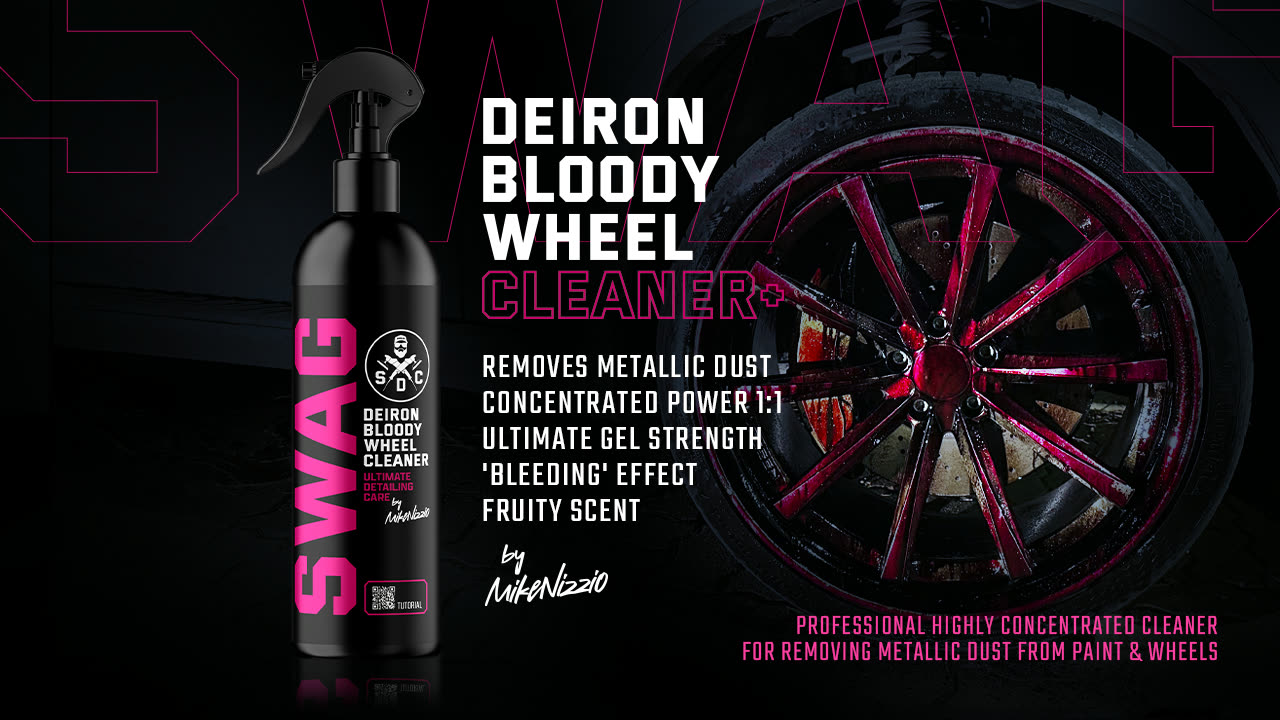
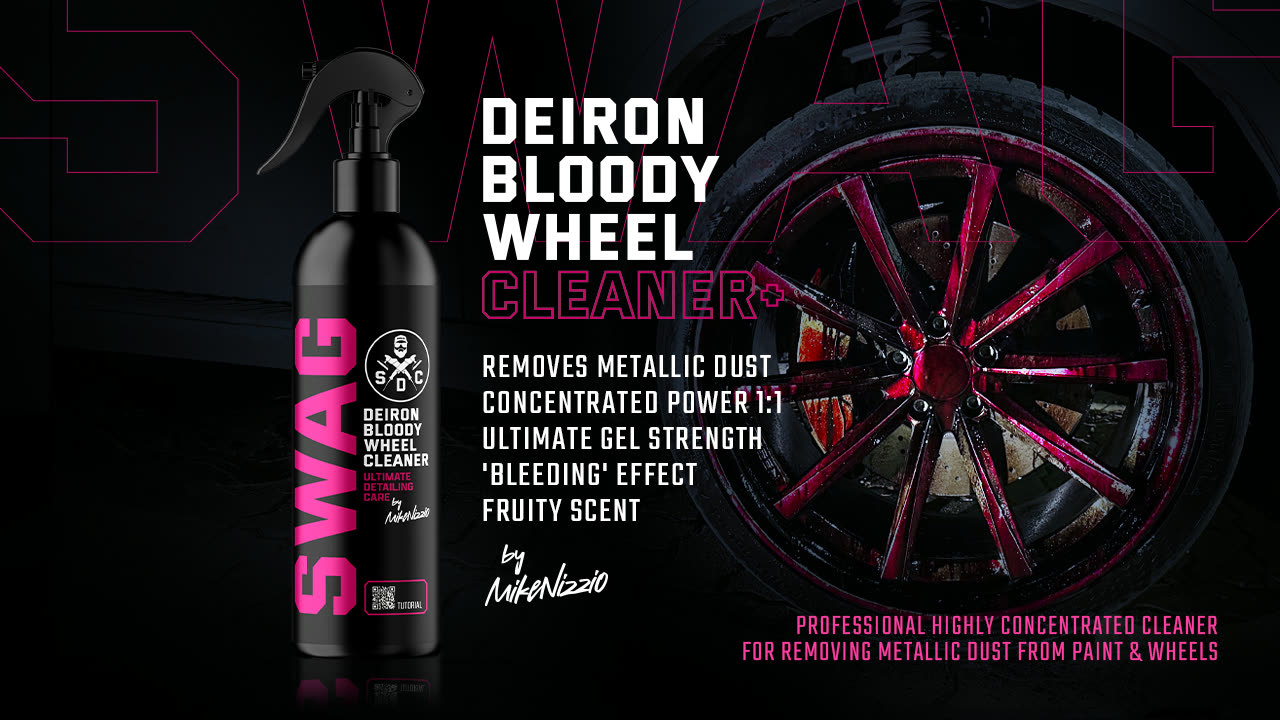
The everyday version I use is DEIRON BLOODY WHEEL CLEANER RTU V.2 — ready to use, balanced pH, safe on both wheels and paintwork, which matters because you want one product for the whole car. On a big job I reach for the DEIRON BLOODY WHEEL CLEANER GEL+ 1:1 V.2.1, because the gel clings to vertical panels and wheel barrels instead of running to the floor before it’s worked. Watch the reaction in real time — this is on wheels, but paintwork behaves the same way:
One caveat: a fallout remover only dissolves iron. It won’t touch tar, tree sap or overspray, so if the paint still feels rough afterwards, that roughness is something else — and that’s what clay is for.
Where it fits in the decontamination order
Chemical decontamination comes before clay, and clay comes before polish. The logic is simple: dissolve everything you can dissolve, so the mechanical steps have as little as possible left to do.
| Order | Step | What it removes |
|---|---|---|
| 1 | Pre-wash and contact wash | Loose dirt and road film |
| 2 | Tar remover | Bitumen, grease, adhesive residue |
| 3 | Iron fallout remover | Embedded metal particles — the orange specks |
| 4 | Clay bar with plenty of lube | Whatever survived the chemistry: sap, overspray, mineral deposits |
| 5 | Polish (only if defects justify it) | Swirls and etching — this one costs clear coat |
| 6 | Protect | Nothing — it puts the sacrificial layer back |
Steps 2 and 3 are the ones people swap or skip. Do them properly and the clay bar has almost nothing left to grab, which is the safest possible way to clay a car — keep it flooded with FLASH CLAY LUBE V.3 and it should glide with no drag at all. There’s a full walkthrough of the tar stage in how to remove tar from car paint. And never finish at step 5: decontamination strips the paint back to bare lacquer, so protection isn’t an optional extra afterwards.
Honest safety notes before you spray anything
Fallout removers smell strongly of sulphur — genuinely unpleasant, like rotten eggs — and that’s normal chemistry, not a faulty bottle. Use them outdoors or somewhere well ventilated, never a closed garage, and wear gloves and eye protection.
Never apply to hot panels or in direct sun. The product has to stay wet to keep reacting; on a warm surface it dries into a stubborn film that then needs scrubbing off. Work in the shade, on cool paint, one or two panels at a time, and give it the dwell time on the label and no more — the reaction finishes long before extra minutes buy you anything.
Then rinse thoroughly: under the arches, around badges and trim, into every shut line the spray reached. Residue left in a crevice is the only way a well-behaved product turns into a problem.
Frequently asked questions
What causes little orange rust spots on car paint?
Iron fallout. Microscopic metal particles from brake dust, railways or industry embed in the clear coat and corrode, and the orange speck is the rust halo around each one. It’s contamination, not a paint defect, and it dissolves out chemically if you catch it before it pits.
Why does fallout remover turn purple?
Because it’s reacting. The active ingredient bonds with metallic iron and converts it into a soluble compound that happens to be deep purple-red. No purple means no iron on that panel — the colour is a live indicator of how contaminated the paint is.
Is iron fallout remover safe on car paint?
A pH-balanced one designed for paint and wheels is, used on cool paint in the shade and rinsed thoroughly. The risks come from misuse: letting it dry on a hot panel, or using an acidic wheel-only product on bodywork.
Do I need to clay after using a fallout remover?
Do the bag test again and let the paint tell you. Chemical decontamination only removes iron, so if the surface still feels rough there’s sap, overspray or mineral deposit left and clay is next. If it feels like glass, skip the clay — no reason to touch the paint mechanically for nothing.
How often should I use a fallout remover?
Twice a year suits most cars — once before winter protection goes on and once when winter ends. Wheels benefit far more often. It’s a reset you do before you protect, not a wash product.
Will it remove a wax or ceramic coating?
It degrades a wax and most sealants, so treat decontamination as the start of a re-protection job. A cured ceramic coating usually tolerates it. Either way, never leave decontaminated paint bare.
If the bag test told you what it tells most people, the fallout removers and clay lubes live in our Decontamination range, and the wheel-specific chemistry sits in Wheels.