Mould on car seats is never really a cleaning problem — it is a water problem that has been left long enough to grow something. Mould needs three things: a food source, warmth and moisture. Your interior supplies the first two permanently, so the only variable you control is the third. That means the job has two halves, and doing only the first is why so many people clean mould off a seat and find it back within a fortnight. This guide covers safe removal, then the more important part: finding where the water is coming from.
In this guideWhy it grew in the first placeProtect yourself firstRemoving mould from fabric seatsLeather and vinyl are differentWhy bleach is the wrong answerFinding the water — the part that mattersDrying the car out properlyKeeping it awayFAQ
Mould does not appear in a dry car
If you have visible mould, water has been sitting somewhere in that cabin for weeks. Not necessarily a puddle — sustained damp is enough.
The common causes are boringly consistent: a door or boot seal that has hardened and stopped sealing, blocked scuttle or sunroof drains backing water into the footwell, a windscreen or rear screen bond that has failed, a heater matrix seeping coolant, or something as simple as a car parked up for a month with damp carpets after a spill.
There is also the seasonal version. A car used for short journeys in winter never gets warm enough or ventilated enough to dry out the moisture people bring in on coats and shoes, so it accumulates. That is the version most likely to affect a car with no leak at all.
Protect yourself before you start
Disturbing mould releases spores, and a car interior is a small, enclosed space. This is not scaremongering — it is the reason to spend two minutes on preparation.
- Open every door and work with real airflow, ideally outdoors
- Wear a mask — a basic disposable one is far better than nothing
- Gloves, because you will be handling contaminated cloths
- Do not dry-brush it first. Dry brushing throws spores into the air; damp removal keeps them in the cloth
- Bin the cloths afterwards or wash them separately and hot
If the growth covers large areas of the seats and carpets rather than a patch or two, be honest with yourself about whether this is a DIY job. Extensive contamination in an enclosed cabin is one of the few interior jobs genuinely worth handing over.
Removing mould from fabric seats
Vacuum with care, clean damp not wet, then dry fast. The last step is the one people skip, and it is the one that decides whether the mould returns.
- Vacuum first, gently, ideally with the doors open. Slow passes, no aggressive beating of the fabric.
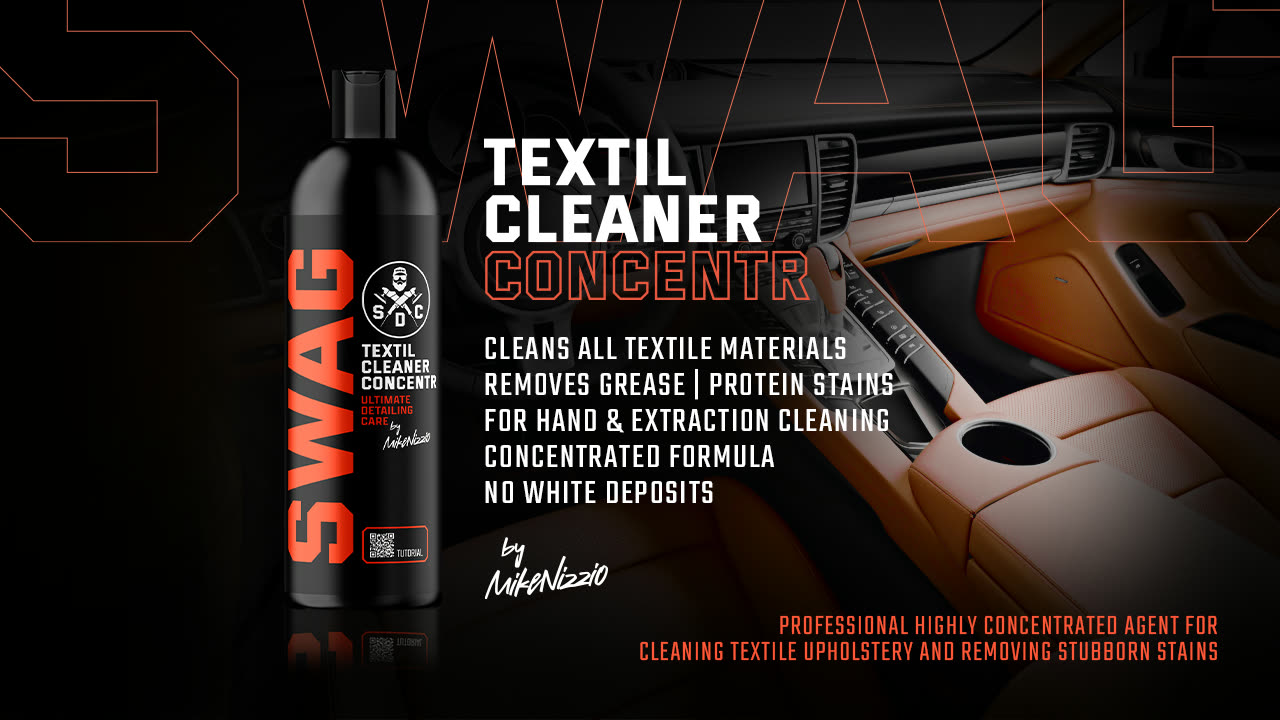
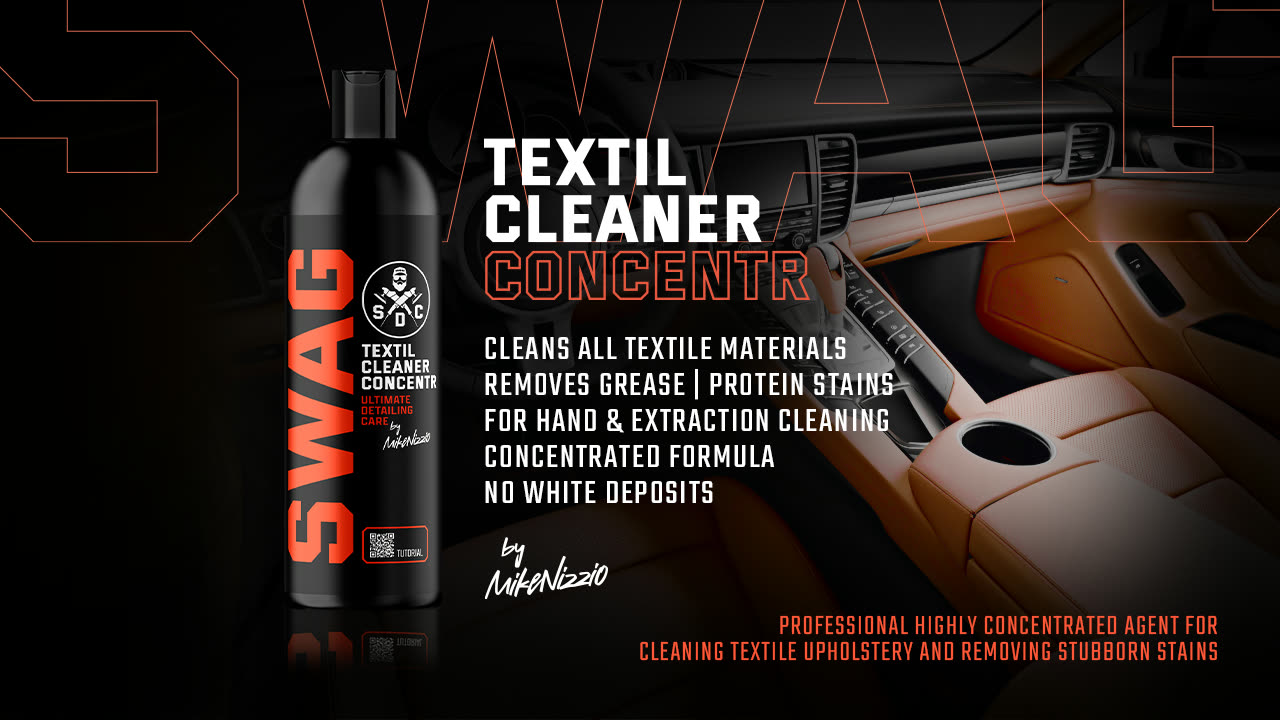
- Apply a textile cleaner to a cloth or soft brush, not directly onto the seat. A pre-spray concentrate such as Swag TEXTIL CLEANER CONCENTR PRE-SPRAY is the right tool here — mix it as the label instructs.
- Agitate gently in one direction, working from the edge of the affected area inwards so you are not spreading it into clean fabric.
- Lift the residue with a clean damp microfibre, turning to a fresh face constantly. This is the step doing the actual removing.
- Repeat on what remains rather than scrubbing harder on the first pass.
- Dry hard and fast — see the drying section below. Damp fabric is how you end up doing this again.
Expect staining to remain even after the mould is gone. Mould pigments fabric, and on light upholstery a shadow often survives the growth. That is cosmetic; the important thing is that it is dead and dry.
Leather and vinyl behave differently — and better
On coated leather, mould sits on the surface rather than growing into it, so removal is usually far easier. It cannot get a grip on a sealed finish the way it can in woven fabric.
Wipe it off with a cloth dampened with a dedicated leather cleaner, working gently, then go over the area again with a clean damp cloth to lift residue. Do not soak, and pay attention to perforations — on ventilated seats the holes lead straight into the foam, which is exactly where you do not want moisture.
Afterwards, treat the leather. Mould removal plus repeated wiping leaves the finish dry, and a conditioner such as Swag LEATHER CONDITIONER CREAM V.2 restores the feel. The reasoning behind that step is in do you need a leather conditioner.
Why bleach is the wrong answer, even though it kills mould
Bleach discolours upholstery permanently, weakens fibres, corrodes the metal seat frame underneath, and adds a lot of water to a car that already has too much.
It is also less effective than people assume on porous materials — it can knock back the surface colour while leaving what is deeper in the fibre alive, which produces the worst possible outcome: a bleached patch that still regrows.
The same logic applies to household bathroom mould sprays. They are designed for tiles and grout — hard, non-porous, replaceable surfaces in a room with a window. A car seat is none of those things. Related thinking on why household products keep letting people down is in the homemade cleaner warning.
Finding the water — the half that actually fixes it
Press the carpet in each footwell with your palm and see if it goes dark or damp. That thirty-second test tells you more than an hour of cleaning.
Then work through the usual suspects in order of likelihood:
- Footwell carpets and underlay — lift them if you can; the underlay holds water long after the carpet feels dry
- Boot well and spare wheel area — a very common hidden reservoir, and easy to forget for months
- Door seals — run a finger round for hardened or lifted rubber, and look for tide marks on the sill
- Sunroof and scuttle drains — blocked drains send water inside rather than out; a classic cause of a wet passenger footwell
- Windscreen surround — damp headlining at the top of the screen points here
- Sweet-smelling damp with misted windows — that combination suggests coolant from a heater matrix, and is a job for a garage
If everything is dry and there is no leak, the cause is almost certainly ventilation and use pattern rather than ingress. That is the easier problem, and it is covered in the damp and musty smell guide.
Drying the car out properly
This is where the job is won or lost. Cleaning adds moisture to a car that had a moisture problem, so drying is not an afterthought.
Open everything and get airflow through it on a dry day — a couple of hours with all four doors open does more than a whole day with them shut. If the weather is against you, run the heater on full with air conditioning on and set to fresh air rather than recirculate, and direct it at the footwells. Air conditioning is a dehumidifier, which is exactly what you need.
Moisture absorbers left in the cabin overnight help, and a fan aimed into a footwell overnight in a garage is genuinely effective. What does not work is closing the doors and hoping — a sealed car concentrates the moisture rather than losing it.
Keeping it from coming back
Once it is clean, dry and the source is fixed, staying ahead of it is undemanding.
- Ventilate regularly — even a few minutes of windows down on a dry day shifts a surprising amount
- Deal with wet items immediately: umbrellas, gym kit, dog towels, wet coats
- Dry rubber mats separately rather than leaving water trapped underneath them
- Check the boot well a few times a year — nobody ever does, and that is why it hides leaks
- Run air conditioning periodically even in winter; it dries the cabin
- Do not store a damp car sealed up for weeks — that combination is what produces the worst cases
Once the interior is genuinely dry, a protected surface holds less moisture and cleans more easily next time — the reasoning is in how to deep clean a car interior.
FAQ
Is mould in a car dangerous?
It is an enclosed space you sit in with the air recirculating, so it is worth taking seriously — particularly for anyone with asthma or allergies. Ventilate while you work, wear a mask, and if the growth is extensive rather than a couple of patches, consider having it dealt with professionally.
Will the stain come out along with the mould?
Often not entirely. Mould pigments fabric as it grows, so on pale upholstery a shadow can remain after the growth is gone. Repeated gentle passes fade it further; aggressive scrubbing damages the pile without improving the colour.
Can I just use an ozone or bomb treatment?
Those treatments target odour and airborne spores, not the growth itself and certainly not the moisture feeding it. Used after a proper clean and dry-out they can help finish the job. Used instead of one, the mould simply comes back.
Why did mould appear after I shampooed my seats?
Because the seats were left damp for too long. Wet upholstery in a closed car is close to ideal conditions for mould. Clean damp rather than wet, extract as much moisture as you can, and dry with real airflow — the method is in how to shampoo car seats.
Should I use an air freshener afterwards?
Only once it is genuinely clean and dry. Fragrance over live mould leaves you with both smells and hides the warning sign you actually need. Once the problem is solved, a fragrance is a finishing touch — see choosing a car air freshener.
The fabric cleaners are in Upholstery Cleaning, and once it is fresh again, Car Scents is the finishing touch.